
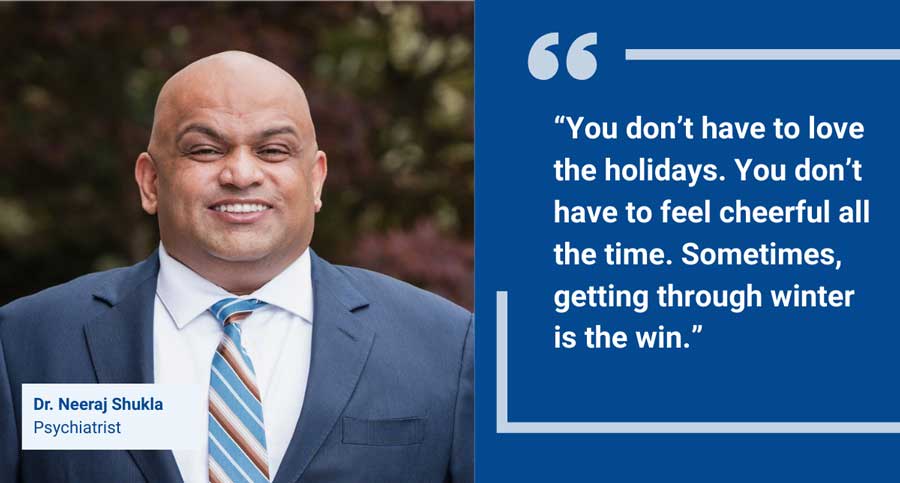
This is an opinion column written by Dr. Neeraj Shukla, Psychiatrist at Niagara Health, published in the St. Catharines Standard, Niagara Falls Review and Welland Tribune.
“It’s the most wonderful time of the year,” they say — usually while it’s pitch black by 4:37 p.m., your to-do list has doubled, someone has been playing holiday music since early November, and five of the top 10 movies on Netflix involve Christmas.
The winter holidays are often portrayed as a highlight reel: cozy gatherings, joyful reunions and people who somehow have both free time and emotional bandwidth.
In reality, this season can bring fatigue, stress, disrupted routines, financial pressure, people mistaking your favourite sweater for your “ugly” one, and complicated feelings about family — whether you’re seeing them or not.
Each year around the holidays, I see this play out in my work, as more patients talk about feeling overwhelmed, exhausted and quietly worried that they’re the only ones struggling.
If you’ve ever wondered, Everyone else seems happy… am I doing the holidays wrong?
Good news: you’re having a very normal human experience.
The holidays can be hard on mental health. No, it’s not just you.
In November, holiday plans feel festive. By mid-December, those same plans can feel like a group project you didn’t agree to. Understanding why this season feels harder can help people recognize what’s happening sooner and respond with a bit more self-compassion.
Some common contributors to seasonal stress include:
Less daylight
Your brain relies on sunlight to regulate mood and energy. Winter reduces that exposure in a meaningful way, especially for people who work indoors or commute in the dark.
Unrealistic expectations
Comparing adult holidays (bills, schedules, responsibilities) to childhood holidays (zero responsibilities and unlimited snacks) is an unfair competition no one wins. Many people feel pressure to recreate a version of the holidays that no longer fits their life.
Disrupted routines
Sleep schedules disappear. Exercise plans quietly unsubscribe. Regular meals and downtime get pushed aside, even though they are often the very things that protect mental health.
Financial stress
Spending tends to increase while energy and patience decrease. That imbalance catches up quickly. Nothing says “Happy New Year” like opening a January credit card statement.
Family dynamics
Seeing certain people, or not seeing them, can bring up emotions that have been waiting patiently for years.
The “holiday blues” usually involve mild symptoms that start in late fall and ease in January. Seasonal Affective Disorder, or SAD, is more severe and can last from fall through spring — close to 40 per cent of the year. Light therapy can help. Light boxes of at least 10,000 lux used for about 30 minutes in the morning have been shown to be effective.
Many people assume stress has to feel dramatic to count. Often, it shows up in quieter ways.
Signs you might be experiencing seasonal stress include:
- Feeling tired no matter how much you sleep
- Irritability triggered by very small things (being stuck waiting for a slow elevator can feel disproportionately upsetting)
- Loss of motivation for activities you usually enjoy
- A strong urge to cancel plans you already cancelled once
- A persistent sense of “I just need to get through this part”
These symptoms are common, valid and not a personal failure at “doing the holidays correctly.”
According to the National Alliance on Mental Illness, 64 per cent of people with an existing mental health condition say the holidays make their symptoms worse. That’s a reminder that this experience is widespread, even if people don’t talk about it openly.
There are some gentle ways to protect your mental health this season. You do not need a complete life reset.
Small, realistic steps can help:
- Practice saying no without adding a long explanation
- Aim for “good enough,” not perfect
- Keep basic routines when you can, especially sleep
- Focus on meaningful connections, not flawless events
- Be mindful with alcohol and comfort eating when stress is high
- Remember that rest is not quitting. It’s maintenance
If you notice changes in mood, sleep, appetite or performance at work, school, or home — or if someone you care about seems to be struggling — reaching out for support matters.
Help is available
You don’t have to power through.
Support is available through organizations such as the Canadian Mental Health Association, which offers free, time-limited counselling. Many private social workers and psychologists can also help you navigate this season and head into the New Year with more stability and fewer unrealistic expectations.
For anyone in immediate crisis or feeling unsafe, our Emergency Department provides 24/7 access to mental health assessment and support.
A final, medically sound holiday reminder:
You don’t have to love the holidays.
You don’t have to feel cheerful all the time.
And you are absolutely allowed to go to bed early on New Year’s Eve.
Sometimes, getting through winter is the win.
