
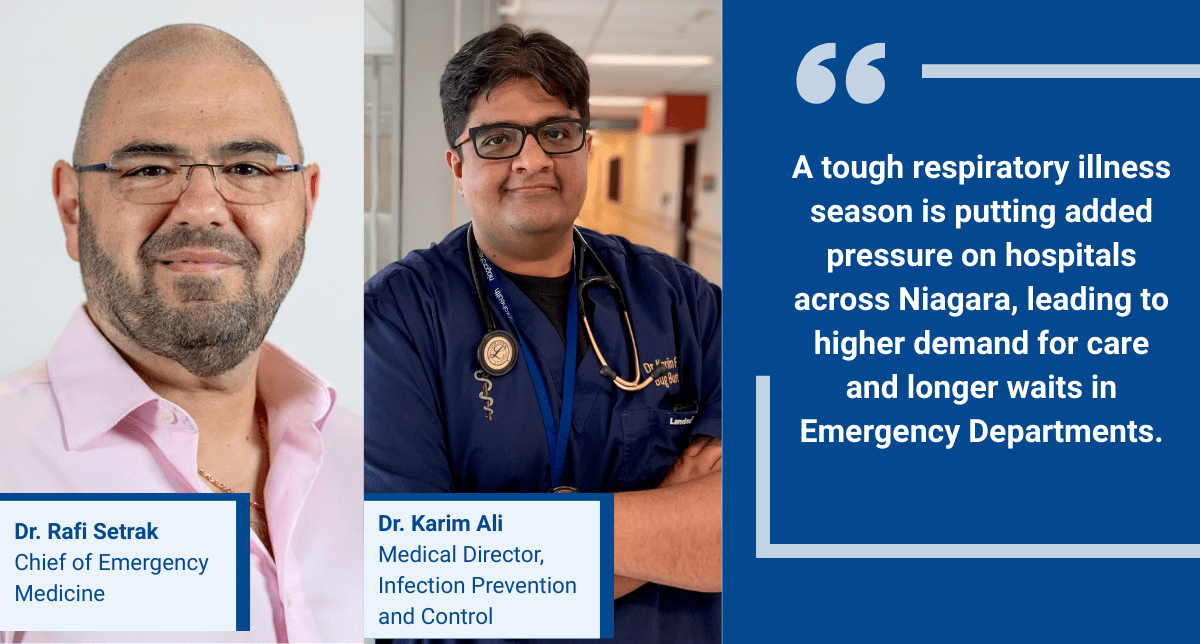
Hospitals across Niagara continue to experience significant pressure as a difficult respiratory illness season drives higher demand for care and longer wait times in Emergency Departments.
While influenza activity is beginning to ease, the impact on hospitals lingers — particularly because patients admitted with respiratory illness often require longer stays and more complex care.
“At its peak just before the holidays, we had 85 patients admitted to hospital with influenza, COVID-19 and RSV,” said Dr. Karim Ali, Medical Director, Infection Prevention and Control, at Niagara Health. “That number has since come down to 47 admitted patients, which is encouraging. But the impacts of influenza don’t resolve overnight, especially for older adults. Recovery takes time, and that affects hospital capacity.”
Patients admitted with influenza and other respiratory illnesses often experience weakness, deconditioning and complications that prolong their hospital stay. As a result, beds remain occupied even as new admissions continue.
In recent weeks, inpatient bed occupancy across Niagara Health has reached as high as 116 per cent. At the same time, 71 patients were designated as Alternate Level of Care — meaning they were medically ready to leave hospital but waiting for community supports — and 94 patients were waiting in Emergency Departments for an inpatient bed. When hospitals are operating beyond capacity, admitted patients remain in the ED longer, which slows patient flow and contributes to longer wait times for everyone.
“When inpatient beds are full, patients who need admission end up waiting in the Emergency Department for a bed to open upstairs,” said Dr. Rafi Setrak, Chief of Emergency Medicine at Niagara Health. “That bottleneck has a ripple effect throughout the entire department.”
Emergency Departments prioritize patients based on medical urgency, not arrival time. Patients with life-threatening or time-sensitive conditions — such as chest pain, difficulty breathing, stroke symptoms, or serious injuries — are always seen first.
“It’s important for people to understand that if they are experiencing an emergency, they should come to the ED or call 9-1-1 without hesitation,” said Dr. Setrak. “Emergency care is what these departments are built for, and that message never changes.”
At the same time, physicians stress that not every illness requires emergency care. Many non-urgent concerns — including sore throats, mild fevers, lingering coughs, minor injuries, or medication questions — can often be managed more quickly and appropriately through other healthcare options.
Choosing the right place for care helps patients and helps the system. Family doctors, walk-in clinics, nurse practitioner clinics, pharmacists, virtual urgent care and urgent care centres all play an important role in keeping emergency departments available for the sickest patients.
For those who do need to visit the Emergency Department, patients are encouraged to come prepared, especially during busy winter months.
“Bring a list of your medications, something to pass the time, and a phone charger,” said Dr. Setrak. “If you’re coming with children, a favourite toy can make a long wait more manageable.”
Niagara Health continues to work on improving patient flow, supporting safe discharges, and strengthening partnerships with community healthcare providers. However, physicians say addressing winter pressures requires understanding and cooperation across the entire healthcare system.
“Our staff are part of this community too,” said Dr. Setrak. “They’re caring for patients while dealing with the same illnesses at home. A little patience and kindness goes a long way during periods of peak demand.”
Doctors emphasize that emergency care remains available around the clock.
“If you’re seriously ill or injured, we are here for you,” said Dr. Setrak. “That is our responsibility, and it’s a promise we take very seriously.”
Know your healthcare options
Health811
Call 811 to speak with a registered nurse for free, confidential advice on where to seek care.
Primary care providers
Family doctors, walk-in clinics, and nurse practitioner clinics for common illnesses, prescriptions, and chronic conditions.
Pharmacies
Ontario pharmacists can prescribe for a range of minor ailments, including UTIs and some cold-related conditions.
Virtual Urgent Care
Same-day care from home for non-emergency concerns. Visit UrgentCareOntario.ca.
Urgent Care Centres
For sprains, minor cuts, mild asthma, fevers, and illnesses that can’t wait for an appointment. Open 10 a.m. to 8 p.m. daily in Port Colborne and Fort Erie. Make sure to check the Niagara Health website before visiting as hours are subject to change.
Emergency Departments
For chest pain, trouble breathing, stroke symptoms, severe injuries, loss of consciousness, serious mental health crises, and other life-threatening emergencies. Call 9-1-1 or go to the nearest ED.
Protecting yourself from respiratory illnesses
Small everyday actions can also help reduce the spread of illness and keep more people well through the winter season, including:- Stay up to date on your vaccinations
- Washing your hands often
- Coughing or sneezing into your elbow or a tissue
- Keeping indoor spaces well ventilated
- Consider wearing a mask, especially in crowded or enclosed spaces. Wearing a mask in public places while sick is also recommended.
- If you are unwell, keeping distance and waiting until you feel better before gathering with others.
- Monitoring symptoms and seeking medical attention if needed.
La saison des maladies respiratoires continue d’exercer de la pression sur les services des urgences
La hausse de la demande de soins et les temps d’attente plus longs aux services des urgences en raison de la saison des maladies respiratoires continuent d’exercer une pression intense sur les hôpitaux de la région de Niagara.
Même si le nombre de cas de grippe commence à diminuer, les effets se font toujours sentir dans les hôpitaux, car les patients ayant une maladie respiratoire ont tendance à être hospitalisés plus longtemps et ont généralement besoin de soins plus complexes.
« Au plus fort de la saison, juste avant le temps des Fêtes, 85 personnes atteintes de la grippe, de la COVID-19 ou du virus respiratoire syncytial avaient été admises à l’hôpital, a déclaré le Dr Karim Ali, directeur médical, prévention et contrôle des infections, à Santé Niagara. Ce nombre a diminué depuis et s’établit à 47, ce qui est encourageant. Toutefois, les effets de la grippe ne disparaissent pas du jour au lendemain, particulièrement chez les aînés. Il faut du temps pour se remettre de cette infection, ce qui a des conséquences sur la capacité de l’hôpital. »
Dans bien des cas, les patients admis en raison de la grippe ou d’une autre maladie respiratoire doivent composer avec une faiblesse, un déconditionnement et des complications qui prolongent leur hospitalisation. Par conséquent, les lits demeurent occupés alors même que de nouveaux patients sont admis.
Au cours des dernières semaines, à Santé Niagara, le taux d’occupation des lits d’hospitalisation a atteint 116 %. Parallèlement, 71 patients étaient désignés comme en attente d’un autre niveau de soins, ce qui signifie qu’ils étaient prêts sur le plan médical à quitter l’hôpital, mais attendaient de recevoir du soutien dans la communauté. De plus, 94 patients aux services des urgences attendaient un lit d’hospitalisation. Lorsque les hôpitaux dépassent leur capacité, les patients admis restent plus longtemps au service des urgences, ce qui ralentit le cheminement des patients et contribue à allonger les temps d’attente pour tous les patients.
« Lorsque tous les lits d’hospitalisation sont occupés, les patients qui doivent être admis se retrouvent au service des urgences en attendant qu’une place se libère à l’étage, a déclaré le Dr Rafi Setrak, chef de la médecine d’urgence à Santé Niagara. Cet engorgement a des répercussions à la grandeur du service. »
Les services des urgences établissent les priorités en fonction de l’urgence médicale et non de l’heure d’arrivée des patients. On y soigne en premier les personnes dont la vie est en danger et celles atteintes d’un trouble devant être traité rapidement, comme des douleurs à la poitrine, des difficultés respiratoires, des symptômes d’accident vasculaire cérébral ou une blessure grave.
« Les gens doivent savoir que, si leur état est grave, ils doivent se rendre au service des urgences ou faire le 9-1-1 sans hésiter, a ajouté le Dr Setrak. Les services des urgences sont là pour traiter les cas urgents. Rien n’a changé. »
Toutefois, les médecins tiennent à souligner que les problèmes de santé ne requièrent pas tous des soins urgents. Un grand nombre de problèmes non urgents, comme le mal de gorge, une légère fièvre, une toux persistante ou une blessure mineure, ou encore les questions au sujet de la médication, peuvent être pris en charge plus rapidement et de façon plus efficace d’autres manières.
Obtenir des soins au bon endroit est bon pour les patients et pour le système de santé. Le recours aux médecins de famille, aux cliniques sans rendez-vous, aux cliniques dirigées par du personnel infirmier praticien, aux pharmacies, aux soins d’urgence virtuels et aux centres de soins d’urgence mineure permet aux équipes des services des urgences de se concentrer sur les patients les plus malades.
Les personnes qui doivent se rendre au service des urgences devraient s’y préparer, surtout pendant la période occupée de l’hiver.
« Apportez votre liste de médicaments, quelque chose pour passer le temps et un chargeur de téléphone, a déclaré le Dr Setrak. Si vous venez avec un enfant, apportez un jouet pour l’occuper. »
Santé Niagara continue de travailler à l’amélioration du cheminement des patients, à la mise en congé sécuritaire et au renforcement des partenariats avec les fournisseurs de soins de santé de la communauté. Toutefois, les médecins estiment que tous les acteurs du système de santé doivent faire preuve de compréhension et unir leurs efforts pour soulager la pression exercée sur les hôpitaux pendant l’hiver.
« Notre personnel fait lui aussi partie de la communauté, a déclaré le Dr Setrak. Il prend soin des patients et doit composer avec les mêmes troubles de santé à la maison. La patience et la bienveillance sont de mise pendant les périodes les plus occupées. »
Les médecins insistent sur le fait que les soins d’urgence sont offerts jour et nuit.
« Si vous êtes gravement malade ou avez subi une blessure grave, nous sommes là pour vous, a précisé le Dr Setrak. C’est notre responsabilité et une promesse que nous prenons très au sérieux. »
Connaissez vos options en matière de soins de santé
Santé811
Faites le 811 pour obtenir gratuitement d’une infirmière autorisée ou d’un infirmier autorisé des conseils confidentiels sur les endroits où obtenir des soins.
Fournisseurs de soins primaires
Les médecins de famille, les cliniques sans rendez-vous et les cliniques dirigées par du personnel infirmier praticien peuvent vous aider si vous souffrez d’une maladie courante ou d’un trouble chronique, ou si vous avez besoin d’une ordonnance.
Pharmacies
Les pharmaciens et pharmaciennes de l’Ontario peuvent prescrire des médicaments pour un éventail de problèmes médicaux mineurs, y compris les infections urinaires et certains troubles liés au rhume.
Soins d’urgence virtuels
Les personnes ayant un trouble de santé non urgent peuvent recevoir des soins virtuels le jour même à partir de la maison. Consultez le site UrgentCareOntario.ca.
Centres de soins d’urgence mineure
On y traite les entorses, les coupures mineures, les cas d’asthme bénins, la fièvre et les problèmes de santé qui ne peuvent pas attendre un rendezvous. Les centres sont ouverts de 10 h à 20 h tous les jours à Port Colborne et à Fort Érié. Consultez le site Web de Santé Niagara avant de vous y rendre pour connaître les heures d’ouverture, car elles peuvent changer.
Services des urgences
On y soigne les personnes qui ont des douleurs à la poitrine, de la difficulté à respirer, des symptômes d’accident vasculaire cérébral, une blessure grave, qui ont perdu connaissance, qui vivent une crise de santé mentale ou qui ont un autre problème mettant la vie en danger. Faites le 9-1-1 ou rendez-vous au service des urgences le plus proche.
Protégez-vous contre les maladies respiratoires
De simples mesures peuvent contribuer à réduire la propagation des maladies et protéger la santé des gens pendant l’hiver. En voici quelques-unes :
- Garder sa vaccination à jour.
- Se laver les mains souvent.
- Tousser et éternuer dans le creux du bras ou dans un mouchoir.
- Bien ventiler les espaces intérieurs.
- Songer à porter un masque, surtout dans les endroits achalandés ou fermés. Il est recommandé aux personnes malades de porter un masque dans les espaces publics.
- Si on ne se sent pas bien, garder ses distances et attendre de mieux se sentir avant de côtoyer des gens.
- Surveiller l’apparition de symptômes et consulter un médecin au besoin.
