
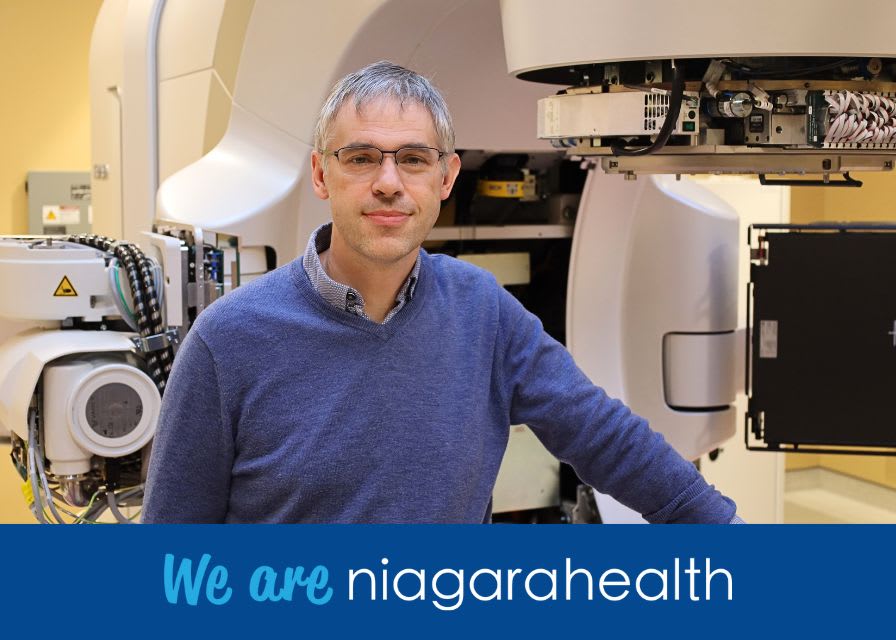
When most people picture cancer care, they think of doctors at the bedside or therapists at the treatment machine. Few know there’s a quiet constant working behind the scenes throughout their entire journey - a medical physicist - making sure every step is safe, accurate and tailored to what patients need most.
At Niagara Health’s Walker Family Cancer Centre, Senior Medical Physicist Josef Dubicki calls it “overseeing the whole pathway.”
From imaging to planning to treatment, his team collaborates with radiation oncologists and radiation therapists while keeping an eye on the full picture: how a scan is taken, how a plan is built, and how the machine will deliver the radiation to a human body.
“It’s our job to understand how each part of the journey influences the next,” says Dubicki. “We’re the only group that follows the entire workflow.”
Balancing precision and people
Radiotherapy is a discipline of millimetres and margins. It’s also life happening in real time. Tumours shrink. Patients lose weight. Breathing patterns change. Those human variables often conflict with the physicist’s drive for absolute precision - and that’s where judgement and compassion come in.
“We train to make everything exact,” Dubicki explains. “But patients are patients. Sometimes you have to let go of the ideal to start treatment when symptoms can’t wait. Experience helps you balance what’s ‘perfect’ with what’s best for the person in front of you.”
One common scenario is lung cancer planning. The team uses a 4D CT scan - a fast scan that captures tumour motion as a patient breathes. If breathing is irregular, therapists call physicists.
“We figure out an approach that truly captures motion so the plan is accurate,” he says. “Because we understand imaging, planning and delivery, we can help troubleshoot.”
As the department’s Radiation Safety Officer, Dubicki also designs shielding and safety systems for new equipment, maintains federal licensing and presents safety cases to the Canadian Nuclear Safety Commission.
“That’s the role only a physicist can do,” he says. “We implement new technology and workflows - safely.”
In large hospitals, collaboration often happens through scheduled meetings. At Walker Family Cancer Centre, it’s a short walk down the corridor.
“We work closely with the clinicians here,” Dubicki says.
Advancing care in Niagara
Trained in the United Kingdom and practicing in Canada since 2015, Dubicki has watched radiotherapy transform. What once existed only in research hospitals - stereotactic treatments that deliver high doses to very small targets - is now available in regional centres like Niagara. Walker Family Cancer Centre is currently replacing all treatment machines and has implemented a new planning system to support this advanced work.
“We’re treating smaller targets with more precision, and that means some patients can be safely re-treated if they need it,” Dubicki says. “It’s satisfying to see people get this level of care close to home, without having to travel to a big university hospital.”
For patients, that impact is simple and profound: treatment that’s targeted, timely and increasingly tailored to how their bodies change over weeks of care.
“That’s the number one thing. Seeing patients do well,” Dubicki says. “Radiotherapy has become the truly targeted therapy we hoped for. And our job is to make sure it stays safe, accurate and humane.”
