
We are Niagara Health is a series of stories that celebrates the incredible people working and volunteering in our organization and how they make a difference in the lives of patients and coworkers every day.
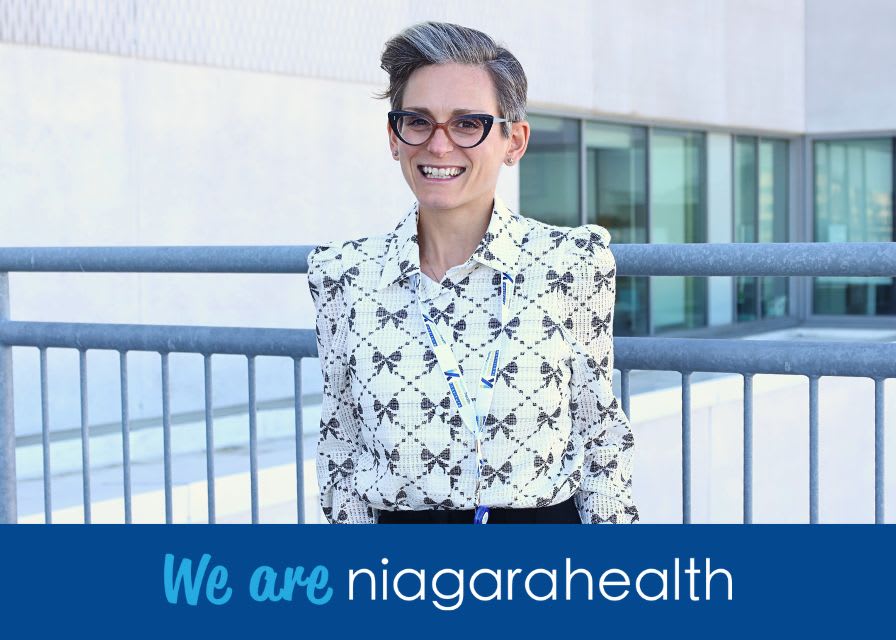
When Elaina Orlando began her academic journey in public health, she never imagined it would lead her to the heart of building a research culture in a community hospital. Today, as the Director of Research Operations at the Niagara Health Knowledge Institute (NHKI), she is helping to shape how research is conducted, taught and shared in Niagara and beyond.
Orlando holds a doctorate in health services research from the University of Toronto, where she specialized in organization and management. Her dissertation examined how physician involvement in quality improvement relates to organizational commitment and engagement.
“I’ve always been interested in how organizations function and how individuals within them can drive broader health systems change,” she explains. “Physicians, in particular, can make transformative impacts when they become engaged at the organizational level.”
Her path to the PhD began with a Master of Public Health at the University of Waterloo and a role as a public health epidemiologist. She wanted to broaden her perspective by understanding the acute care system. That curiosity, combined with strong mentorship, shaped her doctoral research.
“I loved being in school, asking questions and being around new knowledge being generated,” she says.
At the same time, Orlando was working full-time - first as a Quality and Patient Safety Specialist at Niagara Health, and later as Manager of Integrated Transitions in Care.
Balancing these roles with doctoral studies taught her resilience.
“It was a lot of trial and error, adaptation and perseverance,” she recalls. “It also reminded me of the importance of balance - making sure family and work still had space in my life.”
Most recently, Orlando completed a postdoctoral fellowship with the Canadian Critical Care Trials Group. She studied two initiatives designed to support research in community hospitals: providing research funding to 19 hospitals across the country and creating a national community of practice.
“These two actions had a profound impact,” she says. “They gave hospitals the opportunity to launch studies they couldn’t otherwise, retain staff during funding gaps and strengthen infrastructure by developing research policies and procedures.”
The fellowship also reshaped how she views research.
“My favourite finding was how important local context is,” she says. “Hospital culture, the awareness of research, the acknowledgement that it benefits patient care - makes a huge difference. And when community members know we’re doing research, they want to be part of it. That kind of engagement helps us run studies more efficiently and find new treatments faster.”
“Hospital culture, the awareness of research, the acknowledgement that it benefits patient care - makes a huge difference. When community members know we’re doing research, they want to be part of it. That kind of engagement helps us run studies more efficiently and find new treatments faster.”
Orlando brings these lessons into her leadership at NHKI, where she supports eight clinical research programs: cardiology, critical care, emergency medicine, neurology, thrombosis, hematology and transfusion medicine, oncology and infectious diseases.
“No two days are the same,” she says. “We’re recruiting for studies, starting up or closing out trials, and developing tools to standardize our processes. Research is still relatively new here, so we have an incredible opportunity to build something strong together.”
She credits her diverse, collaborative team for much of that success.
“Although each member supports a different program, they constantly support each other and leverage one another’s expertise. That cross-functional teamwork is amazing to see.”
Beyond NH, Orlando is also passionate about education. She taught at Brock University for seven years and now serves as an Assistant Professor at McMaster University, where she co-coordinates a graduate course on qualitative research methods with Dr. Jennifer Tsang, Executive Director and Chief Scientist, Niagara Health Knowledge Institute.
“It’s my first time teaching at the graduate level, and it’s been fantastic,” she says.
“We use real-world examples, including Niagara Health research, so students can immediately apply what they’re learning. It also helps spread awareness of the NHKI to future researchers and clinicians.”
Looking ahead, Orlando is proud of NHKI’s growth and its role in strengthening research capacity across the country.
“We are very proud of what we’ve accomplished as a community hospital,” she says. “By enrolling patients in clinical trials, our team gives them access to therapies they wouldn’t otherwise receive. And by helping other community hospitals launch their own programs, we’re building research capacity beyond our walls - something unique for a community hospital.”
Still, she sees room to grow. NHKI is exploring opportunities in new research portfolios while continuing to stabilize its existing programs. She also hopes to strengthen connections with the community.
“Research is a cornerstone to achieving our organizational goals,” she says. “The more people understand the value of what we do, the more they’ll want to be part of it.”
For more information on the Niagara Health Knowledge institute, visit the NHKI page.
