
This is an opinion column by Niagara Health Communications Specialist Diane Moore, published in the St. Catharines Standard, Niagara Falls Review and Welland Tribune.
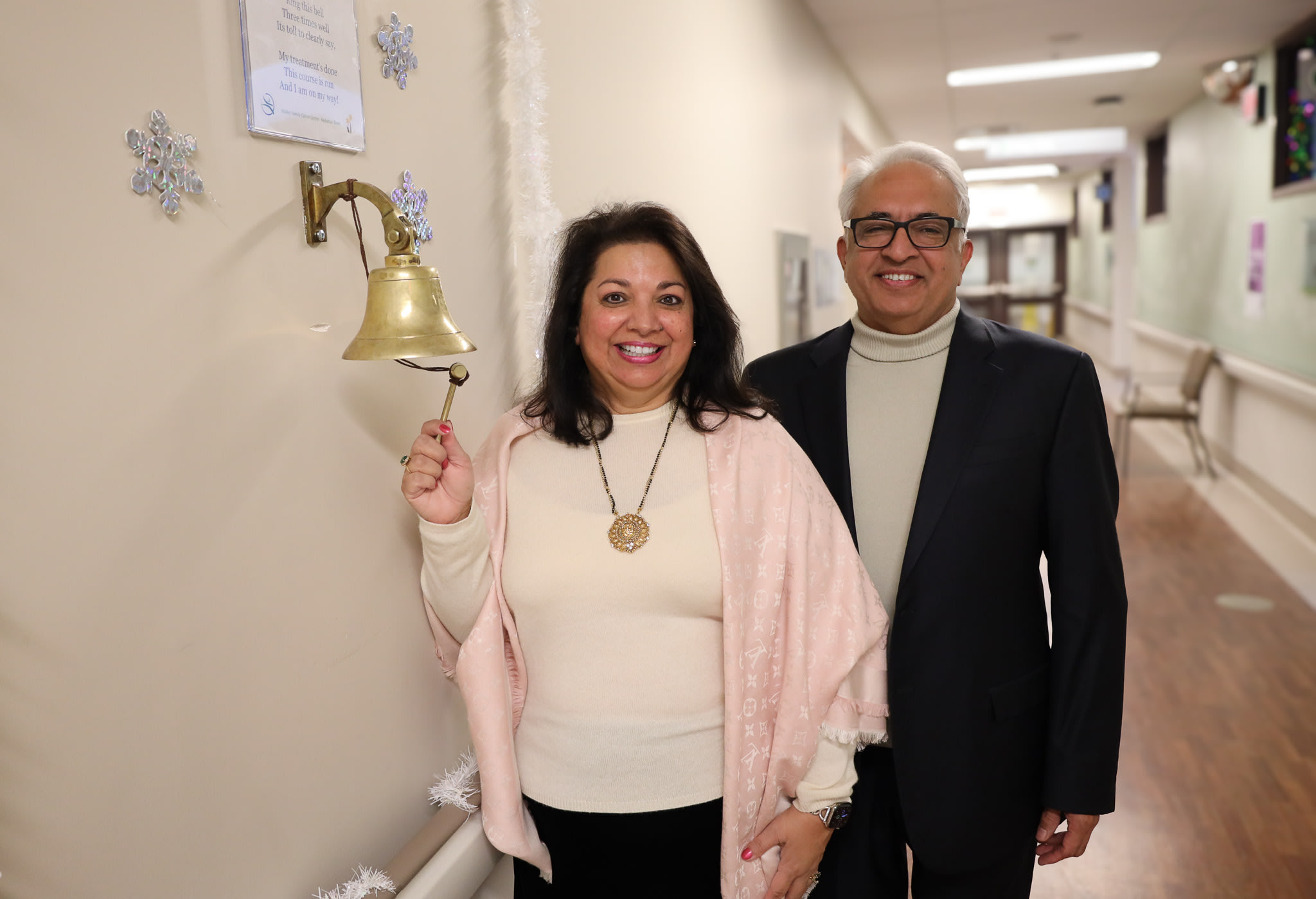 Surabhi Chawla and her husband Dr. Satish Chawla stand next to the bell at Walker Family Cancer Centre that cancer survivors — like Surabhi — ring at the end of their treatment. Surabhi carries the BRCA gene, which can predispose carriers to develop breast and ovarian cancers.
Surabhi Chawla’s journey with cancer started well before her own diagnosis, when her mother survived breast cancer but later died from a secondary cancer, multiple myeloma.
“We were living in Michigan at the time, when my husband's colleague suggested that I have BRCA gene testing done because my mother had breast cancer,” Surabhi says.
Her husband, Dr. Satish Chawla, was working as a pathologist at a local Michigan hospital.
“After some consideration, I decided to take the test,” she says. It came back positive for the genetic BRCA mutation that can cause breast and ovarian cancers.
“I remember Satish’s colleagues saying, ‘if you were my wife, I’d make sure you had a bilateral mastectomy right away.’ But I didn’t want to take such aggressive measures. I was like, no, no, we'll just do what we need to do for now. We'll cross that bridge when we get there, if we ever get there.”
Surahbi had her first MRI mammogram before the age of 40 and began going every year. When the couple moved to Niagara in 2005, she continued the routine tests.
At the same time, Dr. Chawla took on several key roles within Niagara Health to support laboratory medicine, including as Chief of Laboratory Medicine and Pathology.
His focus – improving in-house lab testing for diseases such as cancer.
“Lab medicine is the foundation for everything in a hospital,” he explains. “If you’re a patient who comes here and you’re looking for a diagnosis, your blood tests and biopsies are all sent to the lab first."
It was nearly 10 years later when Surabhi got a phone call after one of her routine MRI mammograms to come back for further testing.
“Dr. Amit Mehta, Deputy Chief Medical Imaging at Niagara Health, ended up performing a same-day biopsy,” she says.
With his own wife receiving a biopsy, Dr. Chawla says he tried to separate his personal feelings from his work; but even today he still gets emotional talking about it.
“I asked my colleague to look at the biopsy,” he says through tears. “I didn’t want to look at it myself.”
Dr. Suhas Joshi, Chief of Laboratory Medicine at Niagara Health, confirmed it was cancer in Surahbi’s left breast - a small, high‑grade triple‑negative tumor.
Surabhi underwent a lumpectomy to remove the tumour along with a small amount of surrounding tissue, and several weeks of radiation treatment at Niagara Health’s Walker Family Cancer Centre. Her friend, Niagara Health’s Dr. Kreasan Rajagopaul, successfully performed the operation. She rang the bell on Aug. 2, 2016, to signify the end of treatment as a cancer survivor.
“Breast cancer was a bump in the road,” says Surabhi. “I was blessed to have a supportive family and an excellent care team. Both my son and daughter, and my daughter-in-law, dropped everything to be with me.”
From early diagnosis to treatment, Dr. Chawla says they were very lucky.
“My wife didn’t have to visit various centres for appointments or radiation treatments as it is all done locally at Niagara Health. They took very good care of her,” he says.
Unfortunately, about one year later the cancer was back, this time in her right breast.
While considering a second lumpectomy and round of radiation treatment, Dr. Rajagopaul, offered Surabhi a harrowing opinion.
“I was blessed to have a supportive family and an excellent care team. Both my son and daughter, and my daughter-in-law, dropped everything to be with me.”
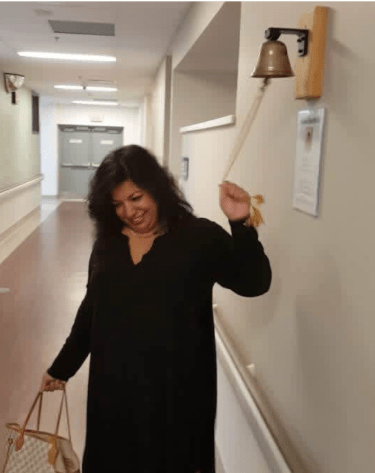
Surabhi Chawla rings the bell at Walker Family Cancer Centre to signify the end of treatment for breast cancer in 2016.
“He told me that because of the type of cancer I had and my BRCA gene, I would likely get breast cancer again. I thought what’s the point of another lumpectomy and radiation treatment?” she recalls.
It was her son who convinced Surabhi to get a double mastectomy to remove all breast tissue to reduce her risks.
“He said to me: ‘Mom, don't you want to be around for your granddaughter? We need you to be alive and healthy.’”
The Chawlas' granddaughter was only a few months old at the time and those words helped Surabhi make the difficult decision. After a double mastectomy, she also underwent surgery to remove her ovaries, as a precautionary measure.
The couple insist that early detection and treatment, along with family support and a positive, determined attitude, were central to Surabhi’s recovery. Both of their children travelled to Niagara to provide emotional and physical support during each operation, while Dr. Chawla provided steady support and optimism.
“I know the team at Niagara Health is amazing,” he says. “So, I wasn’t worried. I also wasn’t worried because she wasn’t worried.”
While most of Surabhi’s testing, diagnosis and treatment took place at Niagara Health, she underwent the mastectomy at Hamilton Health Sciences Centre.
“The care I received at both hospitals was excellent and compassionate,” she says. “Everybody was very loving, supportive, caring, very patient and very accommodating.”
But Surabhi had some rules about visitors during that difficult time.
“I said, you're not allowed to ask how I'm doing because I'm doing fine, but I can't handle your emotions right now. You can't ask me, 'How am I feeling?' You can't say, ‘Oh, I'm so sorry to hear you have cancer.’ So, I gave Satish a list of five rules that visitors were not allowed to say when they came to see me. I needed them to be strong for me,” she says.
Following her surgery, the Chawlas continued their advocacy for cancer care support on the Niagara Health Cancer Crushers team for the annual Big Move Cancer Ride. The couple have been fundraising for cancer care through the Niagara Health Foundation cycling event since before receiving Surabhi’s diagnosis nearly a decade ago, in memory of her mother.
Last summer they both became ‘Platinum Peddlers,’ having received the distinction for fundraising more than $10,000 each.
“Seeing our team and the community come together for this cause is a huge morale boost,” says Dr. Chawla. “It reinforces our dedication to patient care.”
Under Dr. Chawla’s leadership, Niagara Health labs now perform breast cancer biomarkers ER, PR and HER2 testing, helping oncologists start appropriate and effective treatments more quickly. Niagara Health physicians can diagnose 90 to 95 per cent of all cancers within 10 days of biopsies.
Dr. Chawla is now working to bring further studies in-house along with performing biomarkers for cancers such as colon and uterine, among others.
Grounded in Surabhi’s survivorship and Dr. Chawla’s lived experience as both husband and clinician, their journey points forward — urging early high‑risk screening, family voices in care decisions and investment in local diagnostics. All of which can save time and lives.
“I knew cancer was just a bump in the road, and that everybody has their own bumps,” Surabhi says, smiling. “This just happened to be my bump in the road to get rid of my bumps.”
