
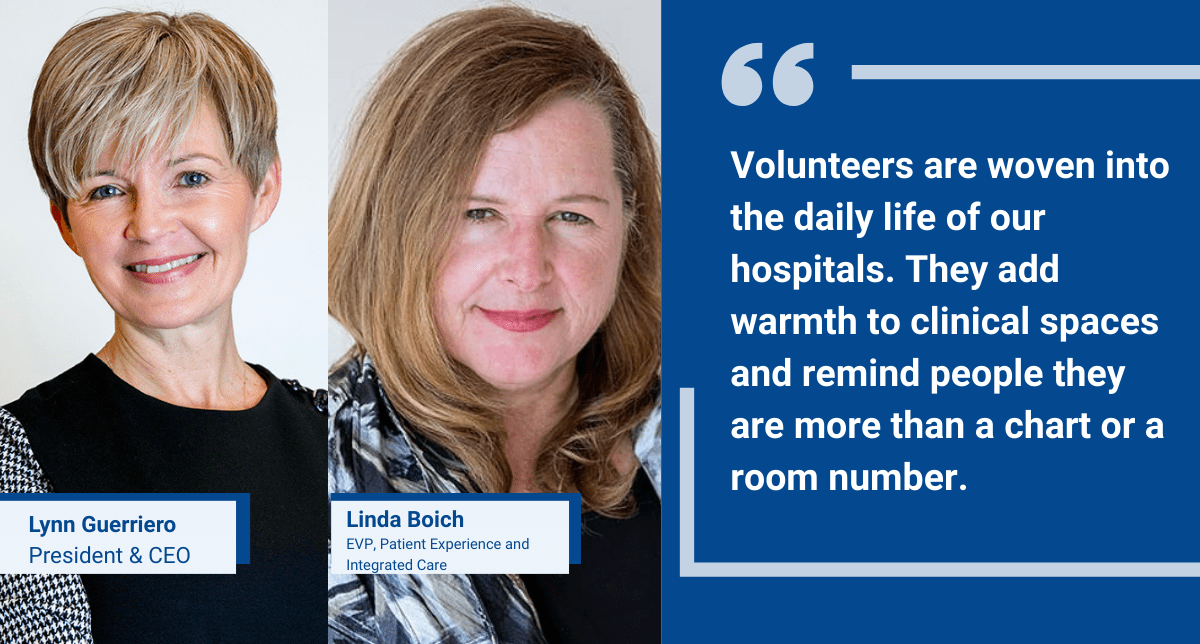
This is an opinion column written by Lynn Guerriero, President and CEO of Niagara Health and Linda Boich, Executive Vice-President, Patient Experience and Integrated Care, published in the St. Catharines Standard, Niagara Falls Review and Welland Tribune.
As we start 2026, I’ve been thinking a lot about what people remember most from a hospital stay.
It’s rarely a piece of equipment or a test result. It’s the human moments: a calm voice in a stressful hallway, someone who takes time to listen, a small act of care that makes a hard day feel a bit more manageable.
That’s where Niagara Health volunteers make a difference. Across our sites, we have 665 volunteers, and their impact shows up in ways that don’t always make the headlines but are felt every day by patients, families and our teams.
Volunteers are woven into the daily life of our hospitals. They support patients and families in waiting rooms, help people find their way, offer comfort items and visit with those who feel alone. They add warmth to clinical spaces and remind people they are more than a chart or a room number.
Our volunteer community also includes the members of our hospital auxiliaries, who focus on fundraising that directly supports patient care. From running our gift shops to leading community fundraisers, their work helps strengthen services and programs across Niagara Health.
Over the past year, we’ve shared the stories of volunteers whose experiences reflect that impact in different ways. We’ve met students who give their time while building careers in healthcare and research. We’ve met newcomers to Canada who volunteer as a way to give back, build confidence and find community. We’ve met parents who once relied on hospital support and now return as volunteers to offer comfort to other families. We’ve also met internationally trained physicians who volunteer while working toward licensure, bringing empathy, calm and deep respect for patient care into busy clinical spaces.
Volunteering at Niagara Health also includes contributing time, experience and perspective in ways that help improve care beyond a single interaction. One important example is our Patient Partner program.
Patient Partners are volunteers who bring lived experience into how we plan, design and improve care. Through the Niagara Health Engagement Network, 75 Patient Partners work alongside staff and physicians to share insight shaped by real encounters with our hospitals. They help us better understand what matters to patients and caregivers and how care is experienced across the system.
Their contributions are practical and grounded. Patient Partners take part in co-design projects, serve on committees and working groups, review patient-facing materials for clarity and accessibility, participate on hiring panels and provide early input on new initiatives. Their involvement helps ensure care is designed with patients and families in mind from the start.
This work reflects a broader shift toward listening more closely, learning continuously and working in partnership with the community we serve.
In healthcare, there will always be pressure. There will always be busy days and tough conversations. Volunteers don’t remove those realities. But they change how people experience them. They bring compassion into moments of stress. They offer reassurance when it’s needed most. They support our teams by complementing the work staff do every minute of every shift.
As we move further into 2026, I want every volunteer and Patient Partner at Niagara Health to know this: your time matters. Your presence matters. Whether you are supporting patients and families in our hospitals, raising funds for care or bringing the patient voice into decisions through the Niagara Health Engagement Network, you are helping us care for our community every day.
And that matters more than any statistic ever could.
For those interested in volunteering with Niagara Health, more information about opportunities and how to apply is available on our website at niagarahealth.on.ca or by calling 905-378-4647, ext. 44423.
