
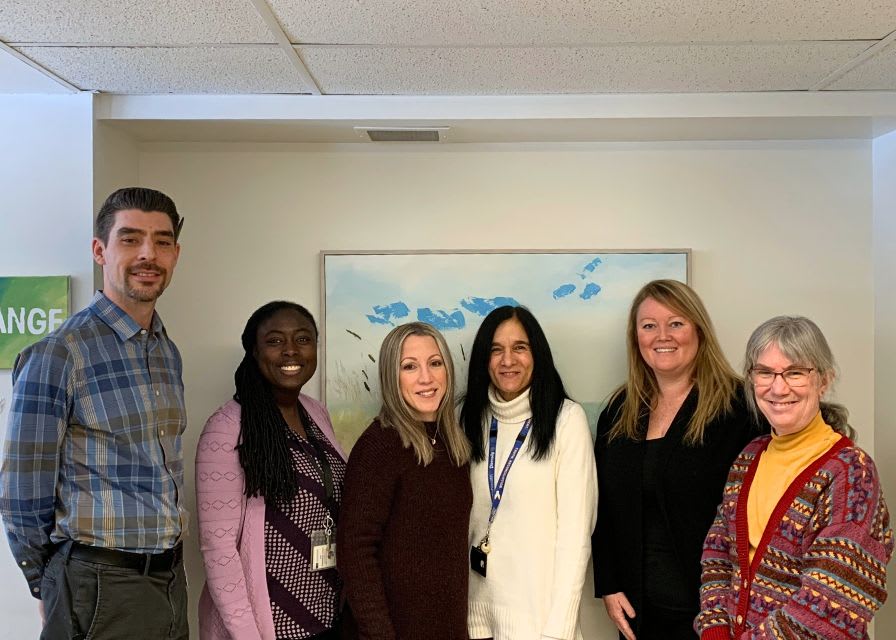
Healthcare programs often evolve, restructure or close — but some remain constant.
For 25 years, Niagara’s Eating Disorder Outpatient Program at Niagara Health has done just that: showing up, week after week, for people navigating one of the most complex and misunderstood medical illnesses.
The program began in the early 1990s as a small psychoeducation initiative. What started modestly has grown into a multidisciplinary service supporting thousands of people across Niagara - not because eating disorders are widely understood, but because they so often remain hidden.
From the beginning, the work demanded nuance.
“Early on, it was clear how layered eating disorders are,” says Dr. Deborah Wilkes-Whitehall, a physician who has been involved with the program since its earliest days.
“There’s mental health, medical stability, trauma, family systems - you can’t treat one piece in isolation.”
“There’s mental health, medical stability, trauma, family systems - you can’t treat one piece in isolation.”
The program begins with a referral from a primary care provider, ensuring ongoing medical oversight from the start.
If appropriate for outpatient care, the next step is a treatment planning session with a social worker. This is where the program’s philosophy becomes clear. Care is shaped around the individual, not the diagnosis.
“We look at where someone is in their readiness for change, what supports they’ve had before, and what they need right now,” explains Carlee O’Rourke, a social worker with the program. “There’s no single path that works for everyone.”
From that point, care may include medical follow-ups, individual counselling, dietitian support and structured group programming. Clients are also connected with trusted external resources and, when needed, supported through referrals to more intensive programs elsewhere in the province. The goal is not to rush recovery, but to offer the right level of care at the right time and to remain in treatment throughout the process.
Each clinician brings a different lens, yet they work from the same place, meeting people where they are.
That phrase ‘where they are’ comes up often.
Recovery, the team agrees, does not follow a straight line. It cannot be reduced to food, weight or willpower. It is gradual, uneven and personal.
“Recovery looks different for everyone,” says O’Rourke, “What we often see is not just changes around eating, but changes in how people live their lives - their relationships, their confidence, their ability to cope.”
Some of those changes are measurable. Others are quieter.
Over time, clinicians notice shifts in how people speak about themselves, how they navigate stress and how they show up in their own lives. Clients who once struggled to manage daily challenges begin using tools they’ve learned, leaning on support, setting boundaries, engaging in self-care - often without consciously realizing how far they’ve come.
Sometimes, the moments that linger most are at the end.
“There’s something incredibly meaningful about the last session,” Dr. Wilkes-Whitehall says. “People don’t just say goodbye, they reflect. Some bring music they’ve learned to play again. Some write poems. Others simply say, ‘I love my life now.’”
Those moments underscore a truth the team is careful to communicate. Eating disorders are not choices, and they are not character flaws. They are serious medical illnesses that affect both physical and mental health and they deserve the same compassion and clinical care as any other condition.
Yet myths persist.
Many people still believe eating disorders only affect young women, or that someone must be underweight to be unwell. In reality, eating disorders can affect people of any gender, age, body size or background. Others assume recovery is simply about food, or that treatment is optional.
“People don’t wake up one day and choose this,” Dr. Wilkes-Whitehall says. “And the person is not the illness. You’re treating a person who deserves respect, dignity and appropriate care.”
That care does not happen in isolation. The program works closely with primary care providers, community partners and provincial networks, including Eating Disorders Ontario, which provides training, shared standards and a broader community of practice.
Evidence-based guidance also informs care through national and provincial frameworks, including Health Quality Ontario and the American Psychiatric Association. For patients, families and caregivers seeking information or support, trusted resources such as the National Eating Disorder Information Centre provide accessible education and guidance beyond the clinical setting.
In recent years alone, the program has welcomed roughly 90 new clients each year, providing thousands of clinical visits - a number that does not capture informal consultations, family guidance, or moments of reassurance that never appear in statistics.
But numbers, while important, are not what define the work.
What defines it is continuity and presence. The decision to remain steady in a space that often demands patience more than quick outcomes.
Eating Disorder Awareness Week, which took place earlier this month, invites broader conversations about stigma, access and understanding, this 25-year milestone is less a celebration and more a reminder: meaningful healthcare doesn’t always make noise. Sometimes, it endures — one person, one appointment, one moment of trust at a time.
