
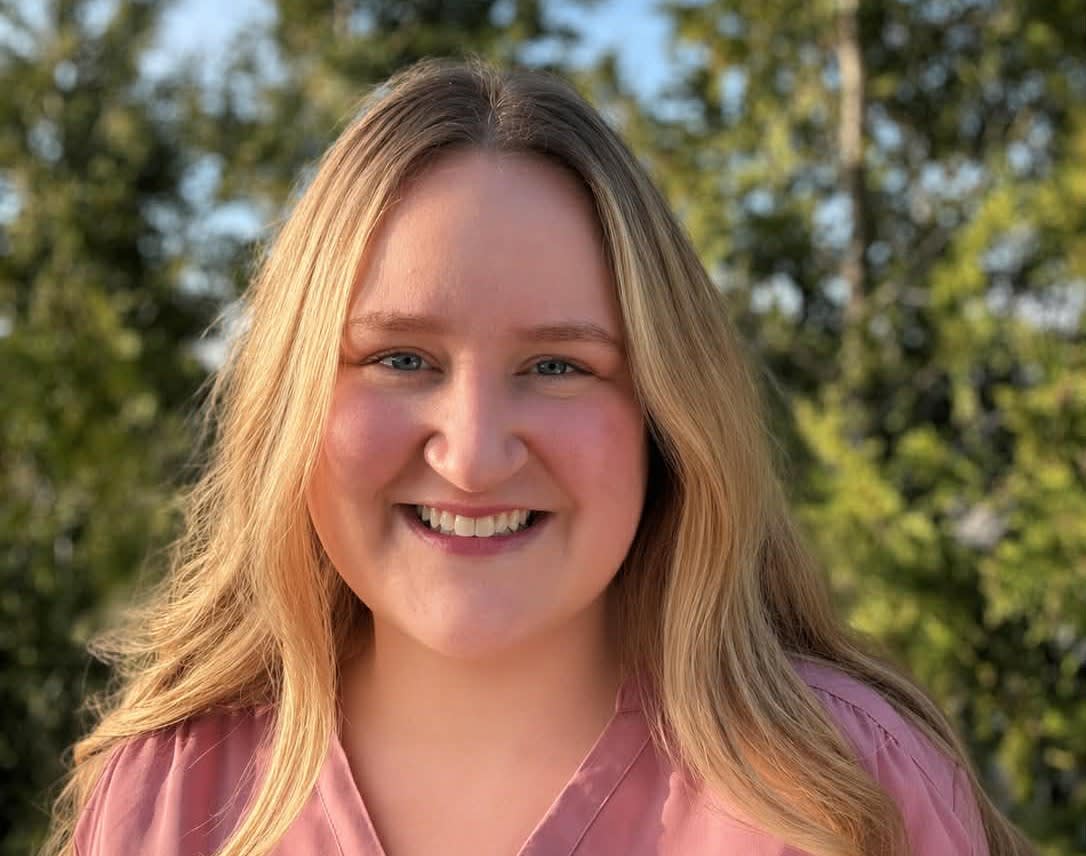
Leigha Comer, a postdoctoral fellow at McMaster University’s Department of Medicine, recently joined the Niagara Health Knowledge Institute. Her role focuses on improving sepsis care for patients across Niagara Health.
Leigha Comer’s roots in Niagara – and Niagara Health – run deep. She grew up in the region and is carving out her own path at the hospital, where both her mother and grandmother worked as nurses.
“They both gave hands-on care that taught me a lot about the ethics of care,” she says. “Their experiences made me privy to things that researchers don’t typically see because they’re often reading literature or conducting interviews on the more corporate side of things.”
That generational insight, paired with her own experience with chronic illness and disability, allows her to bring lived experience and a unique perspective into the research she conducts.
“In healthcare, it’s important to think about who is with patients during their hardest moments – often times, it’s the nurses. In research and policy, they can sometimes be invisible.”
“In healthcare, it’s important to think about who is with patients during their hardest moments – often times, it’s the nurses,” she says. “In research and policy, they can sometimes be invisible.”
Earlier this spring, Comer joined the Niagara Health Knowledge Institute (NHKI) after being recruited by Dr. Jennifer Tsang, Executive Director and Chief Scientist at the NHKI. Dr. Tsang hooked Comer in conversations about the importance of sepsis care at Niagara Health and how it’s a priority.
As a sociologist, work like Comer’s is typically based at universities; however, working at the NHKI has provided her with a unique opportunity.
“I wanted to be embedded in a healthcare system,” she says. “To be able to work directly with clinicians and frontline workers at the hospital and observe clinical areas is a rare, once-in-a-lifetime opportunity. Whenever I tell my friends and colleagues, they’re shocked I have this kind of opportunity and access. The NHKI is breaking down that silo of research and health systems.”
Research has a reputation for being extractive: people are often put under a microscope, included in a publication and then don’t have access to the results of the study, which are often published in journals that are behind a paywall or written in overly academic jargon.
“As an example, a nurse working in the Intensive Care Unit (ICU) might tell me about a certain barrier they face,” she says. “My job is to map out the ‘why’ and then produce knowledge to actually improve things rather than have it sit in a journal that no one but researchers will read.”
For the studies she conducts, Comer creates a one-pager with a plain language summary explaining the study and what the NHKI will do with it.
Afterwards, participants are invited to share, participate in public forums and community engagement opportunities in-person and virtually to learn more about the research.
Sepsis is a life-threatening, extreme response to an existing infection that can lead to irreversible tissue damage, multiple organ failure, septic shock and death. It is often in reaction to a localized infection such as pneumonia, urinary tract infections and abdominal infections.
Rather than fighting the infection locally, the body’s immune system can go into overdrive, resulting in widespread inflammation and blood clotting.
Earlier this year, Niagara Health received a grant to fully fund a study focused on improving how sepsis is recognized and managed in community hospitals, which make up more than 90 per cent of all hospitals in Canada.
The competitive grant, $370,000 over three years, is funded by the Canadian Institute of Health Research (CIHR) and will support the INSIGHTS-Niagara Study.
“This grant marks a milestone for the NHKI, recognizing that research led by community hospitals like Niagara Health can generate locally relevant solutions with national and global impact,” says Dr. Jennier Tsang, Executive Director and Chief Scientist, NHKI.
“The CIHR often funds major, multi-centre studies, and funding a single-centre study in a community hospital is a major mark. The grant means that the scientific community is recognizing the work underway at Niagara Health and building the notion of the importance of engaging and enabling community hospitals to conduct research.”
Dr. Tsang says that it’s crucial for community hospitals to build research capacity. It not only allows hospitals like Niagara Health to give patients access to clinical studies, but enables them to be able to ask research questions that impact the communities we serve.
“Community hospital research is where CIHR sees impact most directly — improving how care is delivered and experienced for patients and families,” says Dr. Paul Hébert, President of CIHR. “This work at Niagara Health will help ensure earlier recognition and treatment of sepsis, with real benefits for residents across the region and insights that can be applied across Canada.”
“Establishing local research capacity is a critical first step toward equitable access to innovation,” she says. “It enables health research that is accessible, inclusive and aligned with the needs of our patients.”
Ongoing sepsis research at the NHKI includes looking at ICUs, Emergency Departments, patient wards and surgical, as well as looking at non-clinical areas and what’s happening at the administrative and leadership levels.
“We’re looking at how sepsis care at Niagara Health is being provided as well as how the teams are resourced, analyzing the sensibility of clinical workflows, making support better for our frontline teams and interviewing patients and caregivers about their experiences,” says Comer.
A key part of this includes looking at equity-deserving and priority populations in the region who are at a higher likelihood of being impacted by sepsis.
“Staying in the mindset that care is going to enable greater equity of justice and improve a person’s quality of life is what makes the NHKI unique,” says Comer.
“My mémère (grandmother), who was my biggest fan, told me, ‘You are needed at Niagara Health and at the NHKI.’ I loved living in more metropolitan cities, but those hospitals are very well-resourced and are typically where everyone wants to be. However, most people get care in community hospitals like Niagara Health, which is what makes the work we do at the NHKI so important.”
Learn more about the NHKI.
