
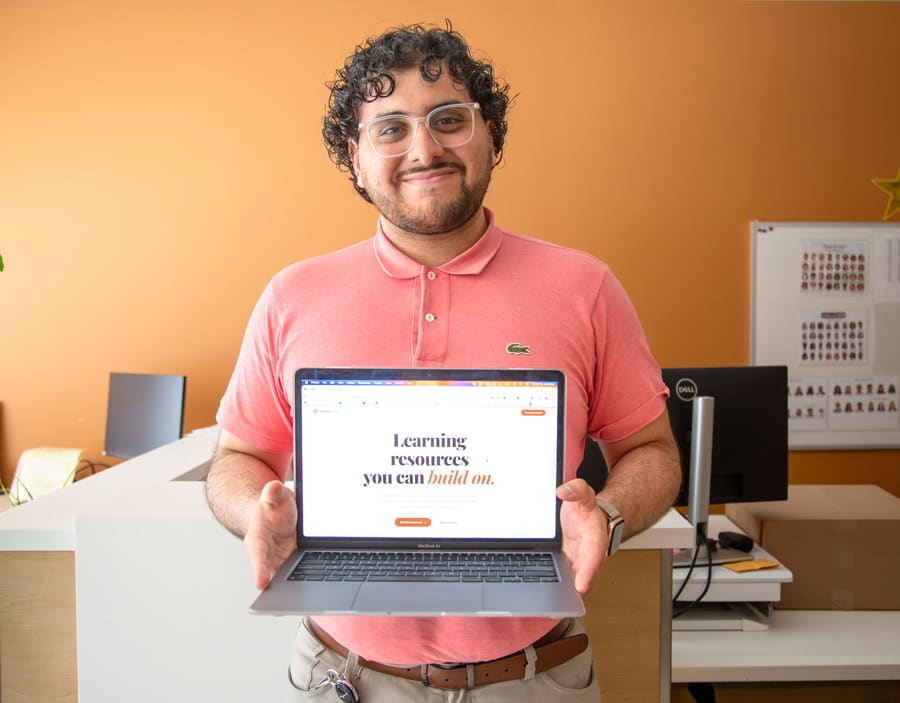
Amr Almasri quickly discovered there were lessons that couldn’t be learned from textbooks or class notes to fully prepare him when he started clinical rotations earlier this year.
As the first person in his family to attend medical school in North America, Almasri also had few people to turn to for advice on the day-to-day realities of learning in clinical settings, be it etiquette in the operating room or understanding the culture of different medical specialties.
"It was a lot of me trying to figure out what to do and how to look good on rotations," says Almasri, a student at McMaster University's Michael G. DeGroote School of Medicine - Niagara Regional Campus (NRC). "You only have a limited time to learn in medical school. There isn’t always time to cover how to write a note, what to do in the operating room or how to become part of the team."
Almasri is trying to change that.
Eight months into his own rotations, he’s sharing the important lessons he’s learned during this critical training period. He’s documenting what he calls the “hidden curriculum” – informal knowledge, professional norms and practical tips – and turning that into resources designed to help his classmates and future medical students feel more confident in a real-world healthcare setting.
Almasri has published a small collection of guides covering general surgery, orthopedic surgery and anesthesia, with plans to tackle other specialties as time and demand permit.
To ensure the information is relevant, he vets the guides with fellow students, residents and staff at Niagara Health and the NRC.
"To help someone live up to their potential and achieve great things, that’s the point.”
“We make sure everything is right and that it’s not just me writing stuff,” he says. “This is ultimately about providing safe patient care.”
He calls the free resources, available online, scaffolding guides. The idea is they provide basics for medical students to build on during their hands-on training with patients, physicians and hospital staff.
Examples of tips include everything from helping anesthesiologists to raise a patient’s bed for easier sedation, getting a resident’s gown and gloves for them in the OR, helping nurses or assisting with patient transfer, and sticking around for clean-up.
All of it is designed to inspire fellow medical learners to take a more active role as they explore different areas of medicine before choosing their future field of practice. Feedback so far tells Almasri he’s on the right track.
“Medical students tend to be on the passive side. They don’t want to be a problem or an obstacle, but we’re more of an obstacle if we don’t put ourselves out there,” he says. “When you put yourself out there, staff trust you more, they show you more and they want to mentor you. You can be a participant and it’s better for patient care.”
Next, Almasri plans to tackle a guidebook to help students with research. He’s also getting requests for a scaffolding resource covering internal medicine.
With each one, he also wants to show medical students they can support each other rather than compete with each other, and that help doesn’t have to come with a price tag.
“I’ve never understood the idea that because someone wants a competitive specialty that they need to gatekeep tips from their peers. I want my co-students to see that we can uplift each other,” he says.
“When I sought help, it wasn’t transactional, so I don’t want this to be either,” he adds. “It’s very rewarding teaching someone and seeing them be successful because of what you may have provided them. To help someone live up to their potential and achieve great things, that’s the point.”
