
This is an opinion column by Michelle Pressé, a communications specialist, originally published in the Niagara dailies.
Fraser Bridgeman’s daughter, Makayla, died in April while in the ICU at Marotta Family Hospital. Through organ donation, Makayla saved the lives of three people, leaving a lasting legacy for her family and the recipients who received her organs. Photo courtesy of St. Catharines Standard.
For Fraser Bridgeman, the greatest lessons she’s learned about unconditional love came from her late daughter Makayla.
“We shared a bond that no one else could ever imagine,” Fraser says. “It was her and I against the world.”
In 2014 at the age of seven, Makayla was just the sixth person in the world to be diagnosed with CTNNB1 syndrome, a rare genetic neurodevelopmental disorder. The syndrome, which shares traits with cerebral palsy, causes developmental delays, intellectual disability, speech impairment and abnormal muscle tone.
Makayla, who was also on the autism spectrum and non-verbal, had additional complex medical conditions. She learned to walk when she was approximately eight but lost the ability to do so as her bones grew during puberty.
Despite the challenges she faced, Fraser says her daughter also experienced extreme happiness.
“Makayla felt joy in a way that most people would never experience,” she says. “She had a child-like love of things – especially animals, shopping, the movie Pinocchio, Christmas and presents. You could give her the exact same doll 50 times and it was like she was at Disney. She was full of life – you couldn’t be in a room with her and not act like a child.”
Earlier this spring, Makayla was hospitalized after the flu she had turned into acute respiratory distress syndrome, a severe, life-threatening complication where heavy fluid rapidly floods the tiny air sacs in the lungs. She was intubated and put on life support in the Intensive Care Unit (ICU) at the Marotta Family Hospital, where it was eventually determined that her lungs could not sustain being removed from intubation.
During Makayla’s 12-day hospital stay, Fraser says the ICU team made the experience one filled with love, respect and dignity.
“The team showed so much empathy and compassion,” she says. “There were toys all over her room and Disney songs playing. The whole ICU has a different vibe when Makayla was there.”
Towards the end of Makayla’s life, her team of nurses were thinking about a wish they could make come true for her as part of the Three Wishes Project, which grants wishes for critically ill and dying patients.
When Registered Nurse (RN) Kim Marcov asked Fraser what she thought might be Makayla’s wish, the answer was immediate: a moment in her ultimate happy place, which was her ball pit.
“Within an hour, someone had gone to Walmart and bought every bag of balls the entire store had and completely filled her hospital bed with them,” says Fraser.
Marcov, along with fellow RNs Jessica Haeni and Jessica Henneke, converted Makayla’s ICU bed and room into a ball pit. It’s the kind of above and beyond care that Francie Davidson, ICU Clinical Manager at Niagara Health, says is the norm in the ICU.
“Nurses are trained to listen,” she says. “When patients aren’t able to go home, we want their loved ones to be able to leave the ICU knowing we’ve done everything and then some.”
While Davidson says Makayla’s family was “over the moon” with the ball pit, it was also healing for the staff to fulfill a wish for her.
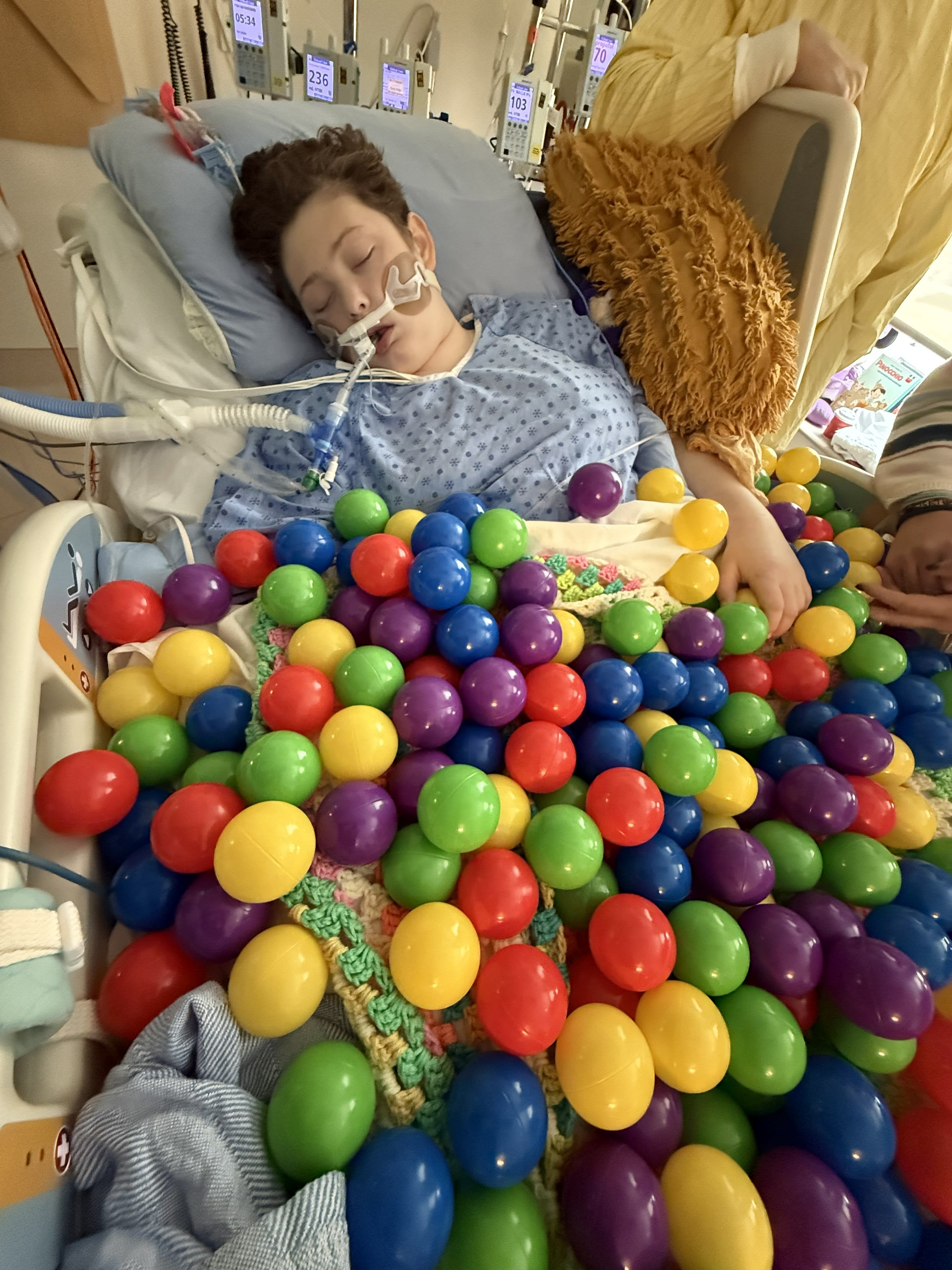
Makayla Bridgeman in her makeshift ball pit bed in the ICU at the Marotta Family Hospital. Photo courtesy of Fraser Bridgeman.
Makayla's hero's send-off. Video courtesty of Fraser Bridgeman.
When it was time to say goodbye, the ICU did something unprecedented: They gave her a hero’s send-off, a tradition in which hospital staff and physicians, as well as loved ones, line the route before the patient, who is also an organ donor, is wheeled away.
“Doctors are often trained not to show emotion, and these doctors cried,” says Fraser. “I could see the devastation in the team’s eyes.”
During the send-off, the song Made for More – Makaylas’ lullaby song – played throughout the hallways as she was brought to a room to be taken off life support. Once there, Makayla was surrounded by Fraser and her uncle and grandmother as they sang Somewhere Over the Rainbow to her as she took her last breath on April 9.
“That day, my family bought out Trillium Gift of Life’s t-shirts supporting organ and tissue donation that were being sold at the hospital,” Fraser says.
April, which is Organ and Tissue Donation Month, highlights the importance of registering to donate. A single donor can save up to eight lives through organ donation and enhance the lives of up to 75 more through tissue donation.
It wasn’t something Fraser had given much thought to until Makayla’s time in the ICU. As she began having conversations about the possibility of organ donation, she was also in touch with a friend whose husband, Rob, needed a kidney transplant.
“Makayla was on day nine of life support and I was beginning to have the talks with doctors you don’t want to have,” Fraser says. “I asked how likely it was for my friend’s husband to be a match and was told it was a one in a million chance.”
Together, Makayla and Rob happened to be that one in a million, and he received the life-saving donation thanks to her gift. Makayla’s other kidney was donated to an 18-year-old girl in Quebec – a girl the same age as her – and her heart went to a woman in Ontario.
“Makayla saved other people from heartbreak,” Fraser says. “She was relentless in her courage. The wait list for organ donation is so long, which is why having these conversations with your loved ones is really important. People don’t have to die unnecessarily.”
Fraser hopes that Makayla’s story and legacy will have a ripple effect by encouraging more people to be organ donors and save more lives.
“The grief is still fresh, but what I’ve learned so far is that grief comes and goes in waves and you just have to try to ride them. Instead of my days always being loud and busy, they’re so quiet now. It helps to know this was for a greater good, even though it’s hard.”
You can register to become an organ and tissue donor in Ontario online in about two minutes at beadonor.ca
