
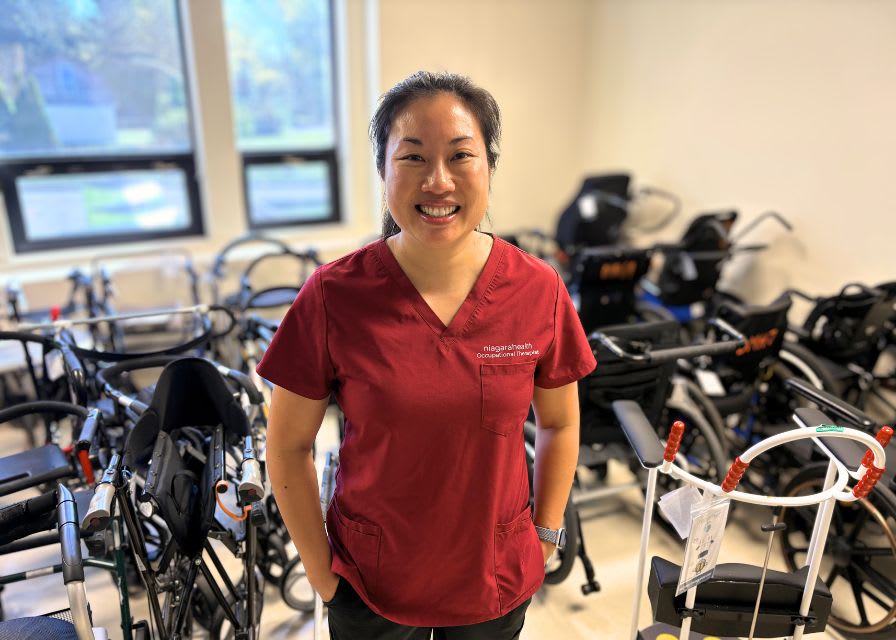
Vickie Ming, Occupational Therapist, Fort Erie Complex Care, helps patients regain the skills and confidence they need to safely return home.
The day a patient leaves the hospital isn't always the end of their recovery. For many, it's the start of figuring out how to safely manage everyday life again.
Can they get dressed independently? Safely move around their home? Prepare a meal? Get to the bathroom without assistance?
Those are the questions Occupational Therapist (OT) Vickie Ming helps answer every day.
"We look at where somebody was before they came into the hospital, where they are now and what they need to safely return to their daily life," says Ming. "Our role is to help bridge that gap."
As an OT at Niagara Health's Fort Erie Complex Care, Ming works with patients recovering from illness, injury and surgery. While medical teams focus on treating the condition that brought someone to hospital, occupational therapists are often focused on another question: what will it take for this patient to return home safely?
"We're constantly evaluating a patient's current status and helping them get back to their previous level of function," she says. “The goal is to help patients return home safely with confidence."
That work often begins early in a patient's hospital stay.
As patients recover, Ming is already thinking about discharge. She assesses how patients are managing everyday activities and identifies barriers that could make it difficult for them to return home. Starting that planning early gives patients time to build skills, practise daily tasks and access supports before leaving the hospital.
“Safe discharge is about more than getting patients home. It's about helping them succeed once they get there,” says Ming.
For many patients, the challenge isn't just recovering from an illness or injury. It's rebuilding the confidence to manage the routines they once took for granted.
"Getting dressed and toileting may seem like very basic activities because we don't have to think twice about them," she says. "But when patients are in hospital, those simple tasks can take a lot of effort and energy."
Ming works closely with physiotherapists, nurses, social workers, discharge planners and community partners to support safe transitions home. Depending on a patient's needs, that may involve recommending equipment, arranging community supports or helping caregivers understand how best to assist their loved one.
By identifying potential challenges before discharge, occupational therapists help reduce the risk of falls, injuries and other complications that could lead patients back to the hospital.
"We think holistically," she says. "We're considering the physical, cognitive and mental abilities of the patient and how those affect their daily activities."
Understanding what matters most to patients helps guide their recovery goals.
"People often think if they can walk, they can do everything else," says Ming. "But we like to ask, 'What are you walking towards?' Are you walking to get that cup of coffee? Are you walking to use the bathroom? It's more than just walking. It's about being able to function in your everyday life."
For Ming, one of the most rewarding parts of the profession is watching patients regain confidence throughout their recovery.
"When we first meet patients, we're often seeing them on one of the hardest days of their lives," she says. "As they recover, you see them regain confidence and start doing things independently again."
For Ming, recovery isn't just about treating an illness. It's about helping people return to the lives they've built.
"We're helping people get back to the things that are important to them. Whether that's living independently, spending time with family or getting back to a routine, that's ultimately what we're working towards."
