
This is an opinion column by Micaela Grant, a communications and engagement specialist, originally published in the Niagara Dailies.
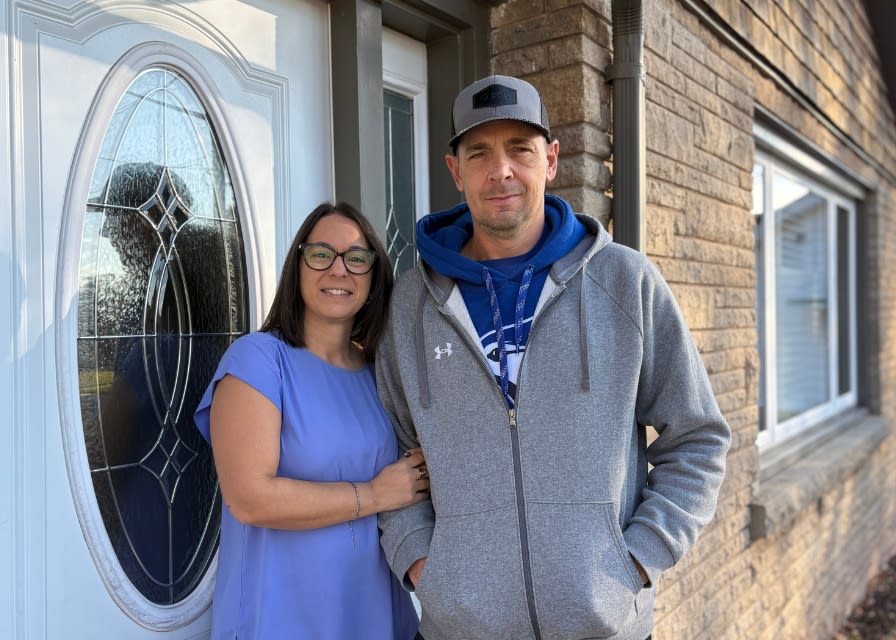
When 43-year-old Steve Eckhardt (right) woke in the middle of the night unable to move the right side of his body, he knew something was wrong. Thanks to the quick action of his wife, Frances Eckhard (left), and Niagara Health's stroke team, the Niagara Falls father is on the road to recovery.
Steve Eckhardt went to bed expecting a long, uncomfortable night.
For weeks, the 43-year-old Niagara Falls resident had been struggling with persistent foot pain. Doctors were working to determine the cause, and sleep had become difficult. As he settled into bed one February evening, he figured the pain in his foot would be the biggest challenge he faced before morning.
Instead, the symptoms that woke him that night had nothing to do with his foot.
When Steve got out of bed in the middle of the night, the right side of his body suddenly stopped cooperating. His arm felt numb. His leg gave out beneath him. Unable to stand, he crawled back to bed and woke his wife, Frances.
Within minutes, she called 911.
Steve was having a stroke.
"I knew something was wrong right away," he says. "When it happened, I pretty quickly realized the signs.”
Paramedics quickly suspected a stroke and transported Steve to the Niagara Falls Hospital, home of the Niagara District Stroke Centre, the regional centre for stroke care in Niagara.
From the moment he arrived, Steve remembers how quickly the team mobilized around him.
"They rushed me for a CT scan," he says. "Everything happened so fast. The doctors and emergency nurses were great."
Imaging revealed a clot blocking blood flow to his brain. The stroke team quickly administered clot-busting medication before arranging an urgent transfer to Hamilton General Hospital for a thrombectomy, a specialized procedure to remove the clot.
The procedure was successful.
"I came out and I was back to normal," Steve says. "I thought that was it."
For a short time, it appeared the worst was behind him.
However, after returning to Niagara Health's Stroke Unit, Steve experienced a brain bleed, a serious complication that required urgent treatment and close monitoring. He spent about 10 days in the Intensive Care Unit and 40 days in hospital before moving to Hotel Dieu Shaver to continue his rehabilitation.
The active father of four and construction worker suddenly found himself relearning movements he had once taken for granted.
"My right leg was dragging behind me," he says. "I worked with physiotherapists in the hospital to help me guide the leg."
Recovery was slow and often frustrating.
"There were definitely tough days," Steve says. "You go from doing everything yourself to needing help. That was hard."
Through it all, he remained focused on getting home.
"My wife and the kids," he says. "That's what pushed me."
For Frances Eckhardt, Facility Site Assistant for the Niagara Falls, Welland, Port Colborne and Fort Erie sites, the experience was overwhelming.
"One minute everything is normal and the next your whole world changes,” she says.
Though Frances has worked at Niagara Health since 2018, experiencing the hospital system as a patient's loved one gave her a different perspective.
"It was comforting knowing there was a good team taking care of him," she says. "We never really felt left in the dark about anything."
Know the signs of stroke
FAST
F – Face: Is the face drooping on one side?
A – Arms: Is one arm weak or numb? Can both arms be raised?
S – Speech: Is speech slurred or difficult to understand?
T – Time: Call 911 immediately.
She says the compassion shown by staff stood out just as much as the clinical care.
"Everyone took the time to explain what was happening. That meant a lot to us."
Today, Steve continues his recovery through rehabilitation, exercise and determination. While the stroke changed his life, it also left him with a deep appreciation for the healthcare teams who cared for him.
Those teams are part of the Niagara District Stroke Centre, which serves patients across Niagara through a specialized team of physicians, nurses, therapists and rehabilitation professionals.
"For every patient like Steve, there's a family going through the experience alongside them,” says Leanne Kent, Manager, Niagara District Stroke Program. “Our role is not only to provide expert stroke care during those critical moments, but also to support patients and their loved ones throughout recovery."
That commitment will continue at the South Niagara Hospital, which will serve as a Centre for Excellence in stroke care when it opens in 2028. Building on Niagara Health's accredited stroke program, the new hospital will provide patients and families with access to specialized treatment, recovery supports, rehabilitation services and community resources.
Looking back, Steve knows how differently his experience could have unfolded had he waited to seek help.
"You never think it's going to happen to you," he says. "If something feels wrong, don't wait. It could save your life."
