
As healthcare organizations across Canada work to grow clinical research and clinical trial programs, Niagara Health is helping shape a national strategy focused on attracting, developing and retaining the workforce behind that research.
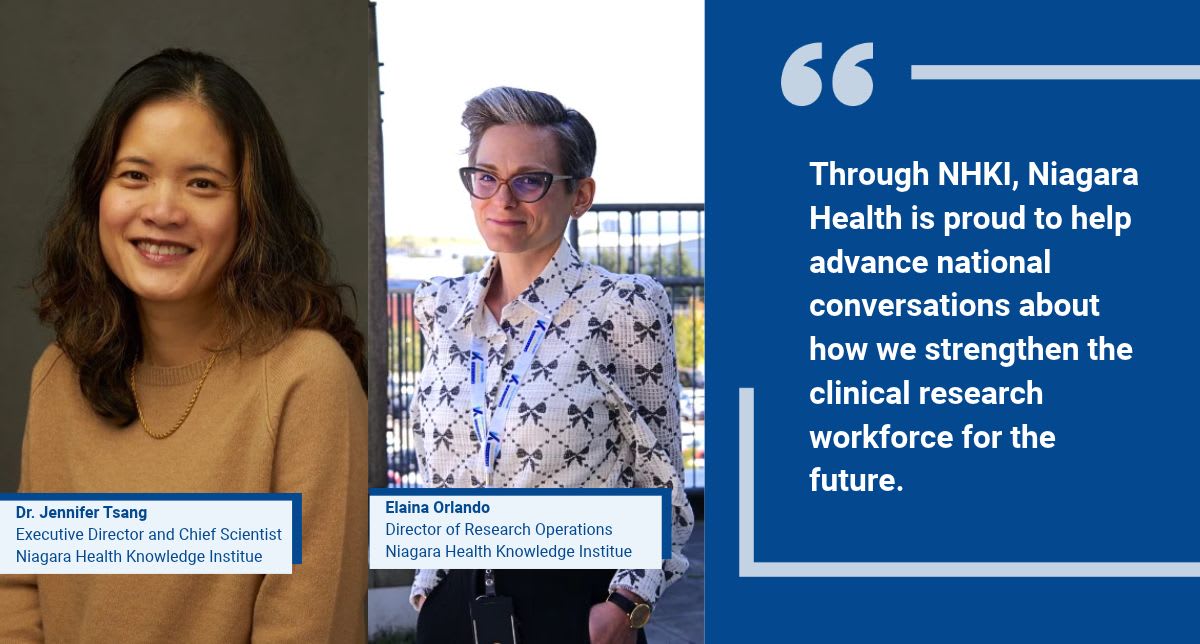
Dr. Jennifer Tsang and Elaina Orlando of the Niagara Health Knowledge Institute (NHKI) are playing key roles in Canada's Clinical Research Workforce Strategy, a national initiative focused on attracting, developing and retaining the professionals who support clinical research across the country. Dr. Tsang, NHKI’s Executive Director and Chief Scientist, serves on the strategy's Leadership Committee, while Orlando, NHKI’s Director of Research Operations, leads its Evaluation and Measurement Working Group.
Their work recently helped inform a national report examining the state of Canada's clinical research workforce. Based on feedback from more than 1,200 clinical research professionals, the report highlights opportunities to strengthen career development, workforce stability and long-term sustainability across the sector.
Many of the findings reflect priorities already embedded in Niagara Health's approach to supporting research staff through professional development, wellness initiatives and a strong workplace culture.
For Niagara Health, the findings reinforce the importance of continuing to invest in the people who support and sustain research programs.
"We have a lot of opportunities presented to us, but it really comes down to the workforce," says Orlando. "People often talk about investigators, pharmaceutical companies and whether there are trials available. The reality is that our limiting factor is the people carrying out the work."
While physicians often lead clinical studies, much of the day-to-day work is carried out by research coordinators and research nurses who support participants and keep studies running. The report highlights the important role these team members play in expanding research programs across the country.
The report reinforces the value of creating environments where clinical research professionals feel supported and can build long-term careers. According to Orlando, that is an area where Niagara Health has been intentionally investing through workplace culture, wellness initiatives and professional development opportunities.
The benefits are being felt locally, with NHKI attracting interest from clinical research professionals who are looking to work in a growing community hospital research environment.
"The work that we're doing around building community hospital research capacity across the country has also generated a lot of interest from clinical research professionals to want to come and work for us," says Orlando.
The report also highlights the role healthcare organizations play in creating stable, rewarding careers for research professionals, an area Niagara Health continues to prioritize.
"The findings align with what we're seeing across the country. Healthcare organizations that want to grow research and innovation need to invest not only in studies and infrastructure, but also in the people who make that work possible,” says Dr. Tsang. “Through NHKI, Niagara Health is proud to help advance national conversations about how we strengthen the clinical research workforce for the future."
