
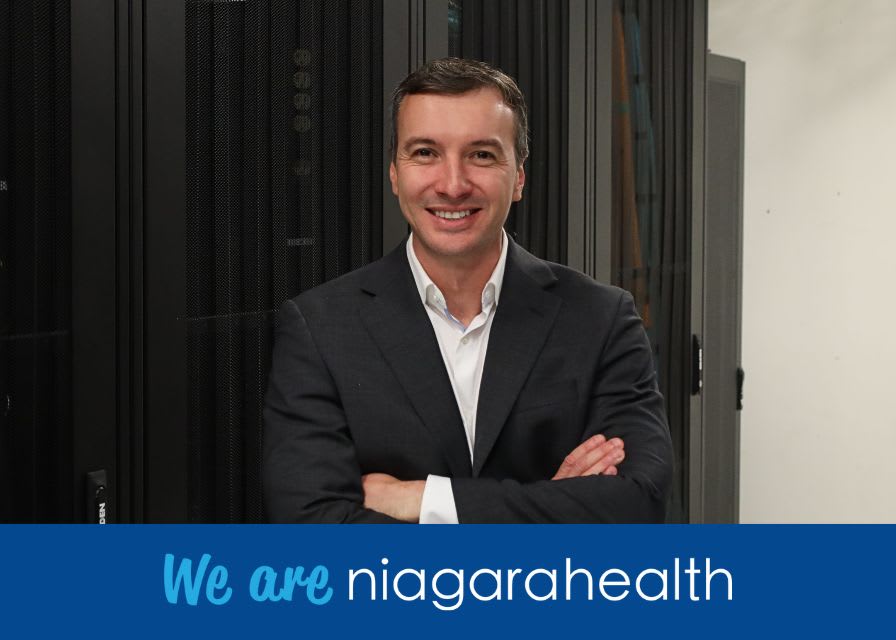
Daniel Rolim pictured in front of one of the data centres which host the IT infrastructure at Niagara Health.
When Daniel Rolim approved a last-minute request to provide internet access for a patient, he assumed it was a small technical favour. Days later, he learned that it allowed the patient to say goodbye to her family - her final call before she passed.
Those quiet, unexpected moments of impact have defined Rolims’s 10 years at Niagara Health - a decade that has transformed him, his team and how technology supports patient care.
Rolim’s passion for technology began at age 15, when he received his first computer. He went on to study computer science, complete an MBA in strategic project management and built a career in IT leadership in Brazil before moving to Canada.
When he struggled to find work in Niagara, people encouraged him to settle in Toronto. He did for a while, but when Niagara Health called about an opening, something drew him back.
“It almost felt like destiny,” Rolim says.
He joined as a Business Systems Analyst, was promoted to Interim IT Manager within months, later became the permanent IT Manager and this year stepped into the Director role, overseeing the service desk, technical teams and Switchboard.
Niagara also became home: his two children, Nicholas and Stella, were born at the Marotta Family Hospital.
“The lifestyle here allowed me to be present as a father while still contributing to something bigger,” he says.
Reflecting on his decade at Niagara Health, Rolim says the milestone is not just a celebration, - it’s a reset.
“It’s a time to look at everything we’ve accomplished, but also to think strategically about the next decade, especially with the South Niagara Hospital opening,” he says.
Rolim thinks often about the responsibility IT carries in shaping how people experience healthcare. Technology has changed rapidly since he started. Ten years ago, phones sat on every desk and nursing station, and data backups were stored on large robotic tape systems.
Today, frontline staff use hands-free Vocera badges to communicate, major systems are redundantly backed up across data centres and cloud environments, and patient rooms in the new hospital are being designed so lighting, temperature and entertainment can be controlled from a single device.
As technology evolves, Rolim’s leadership philosophy remains centred on people. He believes strongly in the importance of creating a team in his department.
“You can’t succeed in healthcare IT without trust,” he says. “My team knows I will support them, but the truth is they support me too.”
Rolim also believes leadership extends beyond the hospital walls. He encourages his team to disconnect, spend time with their families and protect their own well-being.
“If they are taking care of themselves and their loved ones, they will be fit to take care of our community,” he says.
Rolim has learned that big changes in healthcare don’t happen all at once.
“Large investments and major system changes take time,” he says. “But the small steps we take every day, reducing little barriers, improving workflows, adding pieces of technology - they add up. They make our environment safer and improve patient experiences.”
As conversations about AI and automation become more prominent, Rolim is clear about one thing.
“Technology will always be essential, but it cannot replace the relationships that define healthcare,” he says.
To Rolim, technology should create more time for staff to connect with patients, not less.
“It automates what it can so our teams can use the best of their time with people.”
Even today, Rolim still thinks about that patient’s final phone call - a reminder that every technical decision carries human impact.
“When you keep that in mind, the work becomes more than technology. It becomes your purpose.”
