
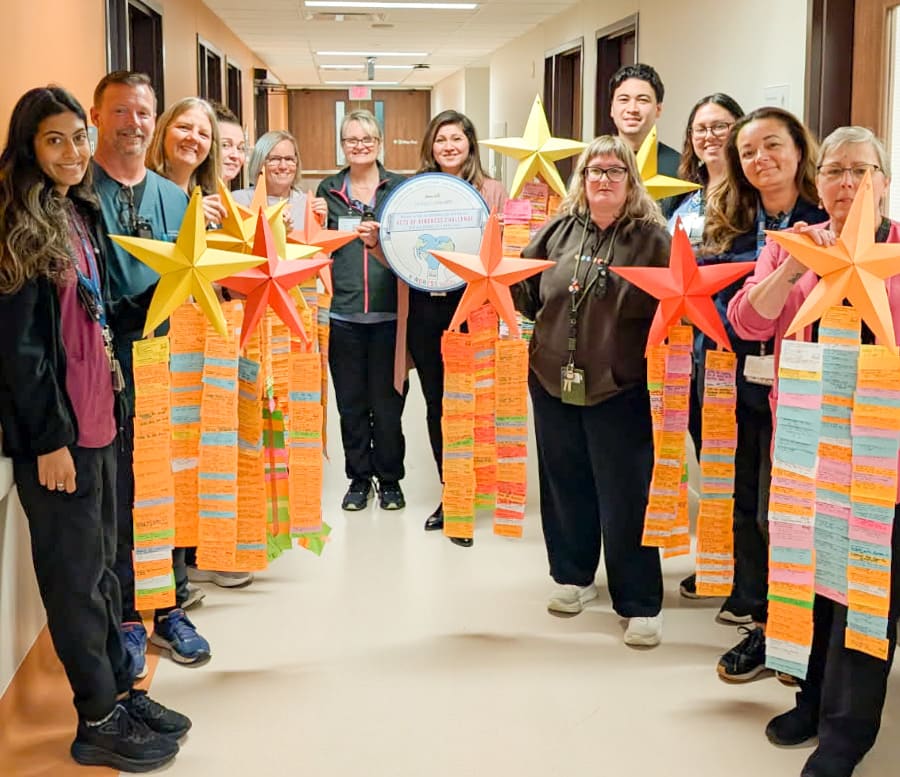
When Clinical Manager Reshma Brouillette started her role in Unit 1A at the Marotta Family Hospital in the summer of 2024, one thing was clear: the Mental Health and Addictions team she oversaw brought oomph and enthusiasm to the demands of caring for patients requiring longer hospital stays.
So it was impossible to miss when an unusual influx of patients needing acute care last winter began to take a toll by spring.
As morale dipped and burnout set in, Brouillette was determined to help her team find its spark again. She turned to a recently revived initiative that had been a guiding light for Niagara Health teams through difficult times.
Enter the Random Acts of Kindness (RAK) challenge, a call to teams throughout the organization to perform 1,000 acts of kindness in a month and showcase those efforts with flair.
“There was an obvious need to put a positive spin on the situation with staff feeling burnt out,” Brouillette says about Unit 1 A. “Taking on this challenge was suggested as a way to uplift each other and highlight the work they do every day that can feel redundant and thankless; however, in reality it doesn’t go unnoticed.
The origins of the RAK challenge at Niagara Health trace back to 2017 in the Information and Communications Technology (ICT) department, which came up with the idea of doing 1,000 acts of kindness in a month.
The premise of the challenge is for individual team members to take stock and highlight kind acts they perform to remind themselves they make a difference in the lives of colleagues, patients, family members and care partners.
The concept spread throughout the organization and over the next two years, Niagara Health staff and physicians racked up 58,000 acts, making teams stronger in the process.
“You get all sorts of kudos externally, but when you recognize internally that you made a difference in someone else’s life, that goes so much further in giving you a sense of achievement."
That momentum was thwarted in early 2020 by the pandemic. The program was paused until last summer when Workplace Relations Consultant Melenie Neamtz hosted an information booth at the Leadership Forum to relaunch it.
“When you sit back and look around, people are already doing this. This is a chance for teams to embrace it and pump it up,” Neamtz says. “When kind acts are happening, we know it. We don’t talk about it, but we experience it and enjoy it. When these things aren’t present, it breaks down the team environment, and we need to pick ourselves up.”
By the end of last year, 30 Niagara Health teams completed 16,500 kindness acts – “the little things that change how you feel about where you work” – showing them off in creative displays.
Environmental Services was the first to step up in July, laying down 2,000 RAKs, which served as inspiration for other teams, including Unit 1A, where the impact has been felt beyond the individual acts, Brouillette explains.
What is kindness?
“When we talk about kindness, we don’t want people to think it’s this big elusive thing,” says Melenie Neamtz, Workplace Relations Consultant. “It’s found in the day-to-day activities people are already doing. What we’re not doing is celebrating those everyday things. That’s the goal of this challenge.”
Kindness is about:
- Offering real support
- Giving specific praise
- Remembering the details
- Being honest
- Acting with empathy
- Standing up for others
- Truly listening
- Celebrating others’ wins
Kindness isn’t about:
- Making big promises
- Flattering people
- Being overly nice
The goal is 58,000 acts of kindness by Niagara Health’s remote and on-site teams by 2027 with Neamtz and the Workplace Relations team available to help get them started.
“You get all sorts of kudos externally, but when you recognize internally that you made a difference in someone else’s life, that goes so much further in giving you a sense of achievement,” she says.
After choosing October as their RAK month, Recreation Therapist Kristen Young and Rehab Assistant Kelsey Nicholls took the lead. They created a display of brightly coloured paper stars adorned with streamers of colourful sticky notes capturing kind moments and hung them in the Unit 1A nursing station as a constant reminder of the team’s efforts.
The nearly 80 staff, physicians and students on the unit tallied 1,107 acts of kindness by the end of October. Space to hang their stars and streamers grew scarce.
The results reinforced what Brouillette already knew: The Unit 1A team are superstars – at their jobs and at kindness.
“It was just so heartwarming,” she recalls. “Every time I was on the unit or we were in a huddle, there were discussions and everyone reminded each other, ‘You did this.’ It just highlighted the cohesiveness of the team.”
Those positive feelings ripple out to the people healthcare is all about, Neamtz explains.
“Whether it’s one act or 1,000 acts, you feel the impact and that feeling extends out to our patients,” Neamtz says. “This is an opportunity to embrace that. We all work in a hospital and I believe the reason we all work here is the same: to help people get better and get home to their families, and kindness plays a part in that.”
Three months later, Unit 1A is still experiencing the emotional high of the RAK challenge. The star display remains in the nursing station, and kindness – and improved morale – abounds.
“When you do something for 30 or 31 days, you build a habit and it becomes a way of everyday life,” Brouillette says. “I see the ongoing kindness on a daily basis.”
