
We are Niagara Health is a series of stories that celebrates the incredible people working and volunteering in our organization and how they make a difference in the lives of patients and coworkers every day.
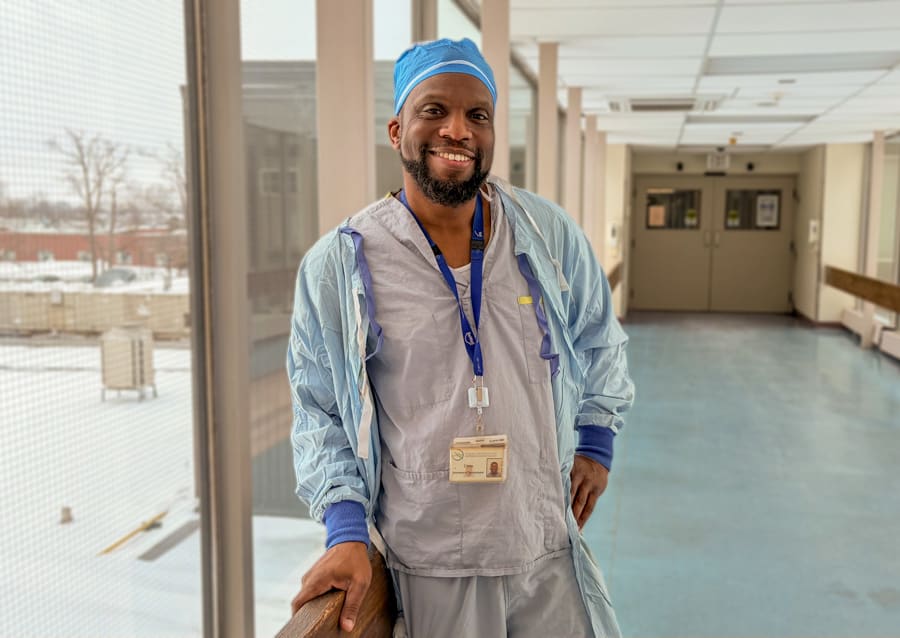
Chris Domize is drawn to people who like to solve problems.
It’s one reason he was fascinated to learn about Jesse Russell, a Black American inventor and telecommunications pioneer whose work played a significant role in the development of the modern-day cell phone.
Without Russell and his innovative work on digital cellular communications, we might all still be taking calls outside and asking, ‘Can you hear me now?’
When Domize, a biomedical technician at Niagara Health’s Welland Hospital, learned about Russell, he shared his discovery with his wife, Nadine, and children, Nya, 18, and Jaiden, 15. Celebrating Black inventors and achievements is just what they do in the Domize household.
“Any time I come across something, I share it with my family,” Domize says. “My wife, who’s a teacher, and kids do the same thing.”
Domize is also happy to let others know, including his coworkers, when he encounters key players or moments in Black History, even if it’s heavy or acknowledges an uncomfortable truth, like slavery.
When he moved to Niagara 13 years ago to work at Niagara Health, he learned about the region’s connection to the Underground Railroad, an organized network of abolitionists who helped African Americans escape enslavement. Niagara Falls and St. Catharines were both stops on the Underground Railroad for freedom seekers.
Domize spent time visiting a burial ground of emancipated African Americans in Niagara Falls and the Salem Chapel BME Church in St. Catharines, where famous abolitionist Harriet Tubman worshipped.
“It was very solemn to be standing in the place where this was happening,” Domize says. “It happened and we shouldn’t turn a blind eye to history.”
“We are your inventors, doctors, scientists, teachers, political activists, neighbours and friends. We have and continue to make significant contributions to our world today.”
Other profound lessons have come during his travels, including to the National Museum of African American History and Culture in Washington, D.C., where each floor represents a chapter in African American history, from slavery through Jim Crow segregation laws and the civil rights movement to the election of U.S. President Barack Obama.
“After leaving the museum it makes you reflect on the events that took place in history – especially imagining oneself being ripped from your home and forced to a life of slavery. There were many who died on the slave ships, disposed of by being thrown overboard,” Domize says. “It’s something we need to remember so that history doesn’t repeat itself.”
That’s why he’s grateful Niagara Health recognizes and celebrates Black History Month. Every February, the organization honours the transformative work and achievements of Black individuals who have shaped our history and continue to influence us today and in the future.
“We are your inventors, doctors, scientists, teachers, political activists, neighbours and friends,” Domize says. “We have and continue to make significant contributions to our world today.”
Domize came to Niagara Health after spending more than a decade working at large hospitals in Toronto and Peel Region. He and his family were seeking a quieter life in a smaller community.
A career in biomedical technology beckoned while he finished studying electrical engineering technology at Seneca College and met a professor who convinced him to take on the challenge and enter the profession. He spent another year specializing in biomedical technology at Fanshawe College after he graduated.
“I was intrigued by working with healthcare equipment,” Domize says. “I enjoy the satisfaction of solving problems for a nurse or a doctor so they can proceed with what they need to do.”
Domize supports the operating room and intensive care unit at the Welland Hospital. In addition to a new job and a region with rich Black history, Domize says he also found a second home at Niagara Health, built on acceptance and respect.
“People treat me on a first-name basis, which adds a personal touch. It’s not, ‘Hey you, fix this!’” he says. There are people who say they don’t see colour. As idealistic as that is, colour exists, and society is shaped around that. However, I don’t feel that here. I’m treated with respect.
“I am welcome here, which I feel is important,” he adds. “It makes the place you go to work feel like home instead of feeling like a place you don’t want to stay for too long.”
