
This is an opinion column by Niagara Health Communications Specialist Maria Pashynsky, originally published in the Niagara dailies.
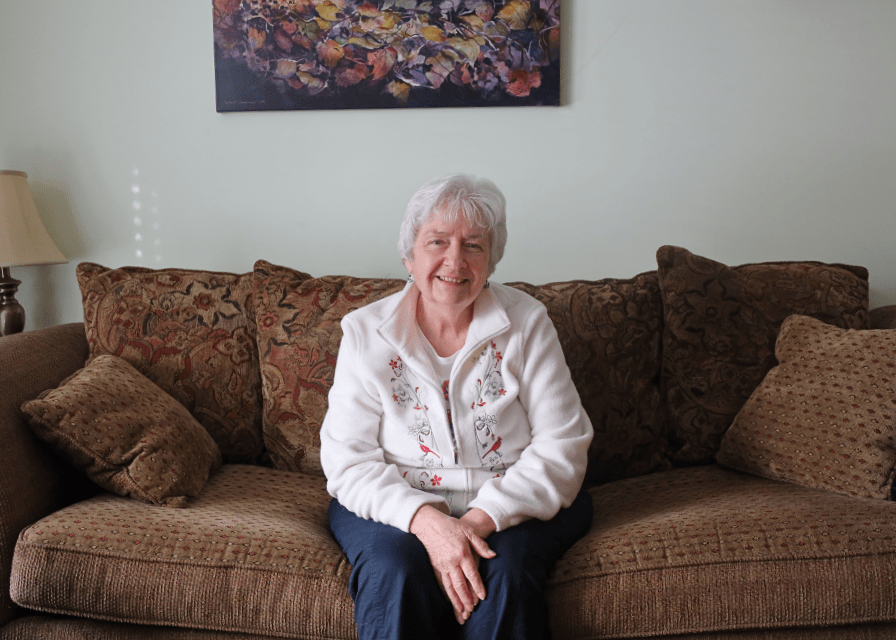
When Sandy McBay sat in the chemo pods at the Walker Family Cancer Centre more than a decade ago, she couldn’t help noticing who was sitting alone.
“Sometimes people had someone with them, but many didn’t,” she recalled. “It’s a very scary time when you’re starting treatment. You just need somebody to walk alongside you, even if it’s only for a few minutes.”
Those quiet observations, paired with a lifelong belief in caring for others, eventually led McBay to become a pastoral care visitor and later a Niagara Health Patient Partner, using her own experience as a patient to support others and help shape care.
McBay was first diagnosed with breast cancer in her left breast in 2013. She had a lumpectomy with a second surgery to clear additional margins, followed by chemotherapy and radiation at the Walker Family Cancer Centre.
“The care was always incredible. The nurses were very tender, engaging and monitored me very, very well.”
“The care was always incredible,” she says. “The nurses were very tender, engaging and monitored me very, very well.”
Treatment wasn’t easy. She remembered a serious infection that led to an overnight stay in the Emergency Department and how physically and emotionally draining chemotherapy could be.
“Radiation was better than chemo in some ways,” she says. “Both departments took very good care of me. What I really appreciated was that they were looking beyond the disease and treating me as a person.”
Her treatment wrapped up around the end of 2014, followed by several years of follow-up care. Life slowly returned to a new normal.
In 2019, a routine mammogram showed a new concern in her right breast. McBay had surgery and started a brief course of chemotherapy.
“I finished treatment in 2019, and I had a mammogram a few months ago and everything was clear,” she says.
‘Patients can be the experts in their own care’
McBay often says patients can be the experts in their own care, a philosophy rooted in her own experience of hearing the words “you have cancer.”
Her first diagnosis came while she was at her sister’s cottage. McBay’s physician called with the results, and as soon as she hung up the phone, her sister - a retired nurse - immediately started planning the next steps.
“She said, ‘All right, we’re going to do this and this,’” McBay recalls. “And I had to say, ‘No. Let me just be with this information for a little bit first. Then we’ll start talking about a plan.’”
For McBay, that pause mattered.
“When someone gets a difficult diagnosis, there’s a natural desire to jump right into it,” she says. “But sometimes we need time to internalize the information before we move forward. If we’re given that opportunity, I think it strengthens us a little bit.”
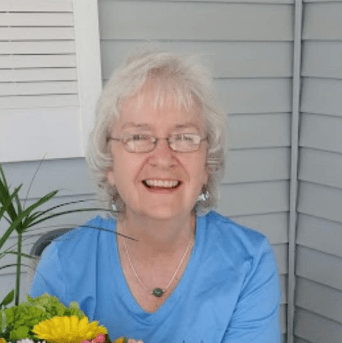
McBay’s perspective closely reflects Niagara Health’s Know Me element of patient experience, one of six guiding principles focused on seeing and supporting each patient as a person first.
She believes that, with good information and support, patients are often capable of more than they think.
“We know our own bodies and our limitations,” she says.
McBay’s views on care were also shaped by personal loss. Her husband died suddenly 15 years ago, an experience that deepened her understanding of fear, uncertainty and the need for presence in moments of crisis.
“As we get older, many of us try not to burden our families,” she says. “But I’ve learned how important it is to let people show up and how much that matters when something feels overwhelming.”
Learning to ‘walk alongside’ others
After her first cancer treatment, McBay felt a growing pull to support others. While studying at McMaster Divinity College, she enrolled in an intensive pastoral care course offered through Niagara Health’s chaplaincy program.
Her first assignment was in the Emergency Department, simply being present for people in difficult moments, including walking outside with a man whose father had just died.
McBay eventually returned to oncology as a volunteer visitor, this time on the other side of the treatment chair. She introduced herself to patients, offering company when they wanted it.
“You could tell within thirty seconds if someone wanted you to stay,” she says. “Most did.”
McBay described herself as a person of faith, grounded in a church community she has belonged to for more than four decades. While faith sustained her through cancer treatment, she says its influence was often clearer in hindsight than in the moment.
“When I look back, I can see where the support was,” she says. “At the time, you’re just doing what you need to do to get through."
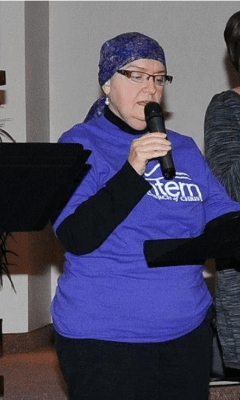
From patient experience to Patient Partner
McBay’s involvement in improving care began years before the Niagara Health Engagement Network (NHEN) Patient Partner program formally existed. She first joined the Patient and Family Advisory Council (PFAC) around 2016–17, a group she now sees as the earliest precursor to the Patient Partner program.
Members shared practical ideas rooted in lived experience, including small but meaningful changes like adding padding to the hospital’s sturdy blue wheelchairs to make waiting more comfortable.
Patient Partners like McBay play a vital role in shaping how care is delivered at Niagara Health, says Caroline Campbell, Senior Patient Partnership and Relations Specialist.
“Patient Partners like Sandy work alongside our staff and physicians to ensure the patient perspective is reflected in everything we do,” Campbell says. “Whether through committees, co-design sessions, hiring panels or many other initiatives, Patient Partners have a meaningful voice at the table.”
McBay also began providing New Patient Orientation at the Walker Family Cancer Centre. As someone who had gone through treatment herself, she walked new patients and their families through what they could expect.
“I think having a current or former patient speak lent a sense of legitimacy,” she says. “It helped people feel less alone at the very beginning.”
When Niagara Health formally launched its Patient Partner program, McBay was part of the group invited to help mark its beginning.
Since then, McBay has contributed to a range of initiatives, offering feedback on patient information materials, participating in discussions about care environments, and sharing insight on how spaces and communication could feel calmer and more welcoming for patients and families.
Recently, she was invited to provide feedback on mural concepts for oncology and palliative care spaces - work she felt strongly about after seeing firsthand how art could help ease anxiety for patients waiting for treatment.
“Sandy has made meaningful contributions as a Patient Partner, always bringing forward her perspective with kindness and empathy,” Campbell says.
For McBay, patient partnership is ultimately about presence, noticing who might be sitting alone, asking the questions others might not think to ask, and reminding healthcare systems that listening is not a courtesy, but a responsibility.
“The very fact that hospitals are asking for patient input tells me they’re serious about improving care,” she says. “That willingness to listen, to really listen - can make healthcare more human. If my experience can help even a little bit, then it’s worth participating.”
