
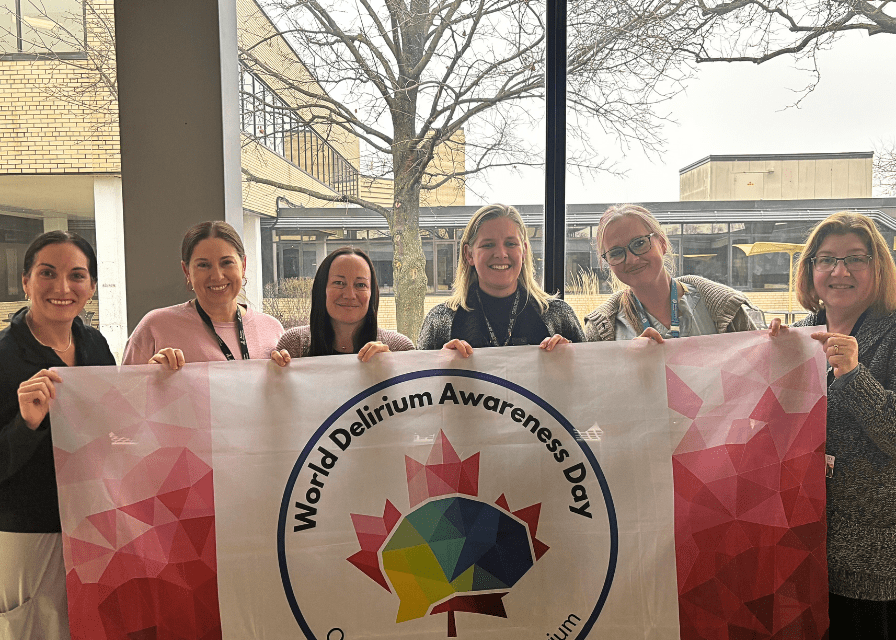
A bright flag bearing the words “World Delirium Awareness Day” made a meaningful stop at Niagara Health this winter and has since continued its journey across Ontario.
The flag is part of a provincewide initiative led by the Regional Geriatric Program of Ontario, which has been moving from hospital to hospital to spark conversations about delirium.
Niagara Health received the flag from Rural Oxford Health Services in Ingersoll and, after marking the occasion with staff, passed it along to the next participating organization.
For the Geriatrics team, the visit was more than symbolic.
“Our hospital environments are incredibly busy, and yet so many people took time out of their day to come and be part of this,” said Julie Rubel, Geriatrics Clinical Nurse Specialist. “That was very meaningful and exciting.”
The group photo included members of the inpatient and outpatient geriatrics teams, interprofessional staff, organizational leaders and Care for Older Persons champions staff from across Niagara Health who have stepped forward to strengthen geriatric expertise at the point of care.
While the flag itself was new to many, the work behind it is not.
Niagara Health has acknowledged World Delirium Awareness Day for more than five years, building awareness among staff and increasingly sharing public-facing education. With March 11 recognized globally as World Delirium Awareness Day, the flag’s visit offered an opportunity to extend that message beyond hospital walls.
Delirium is a sudden change in a person’s thinking, behaviour or level of awareness that develops over hours to days. It often presents as an abrupt shift from a person’s usual cognitive or functional baseline. Family members or caregivers may notice that their loved one seems more confused, disoriented, withdrawn or agitated than usual.
Older adults, particularly those with dementia or other cognitive vulnerabilities, face a significantly higher risk.
“There are real risks that hospitalization presents for older adults,” Rubel explains. “When you think about the Emergency Department environment - the sights, sounds, reduced ability to move around, those things can contribute to delirium and deconditioning.”
Deconditioning, the rapid loss of muscle strength and function, can occur quickly in older adults. Even a single day in bed can lead to measurable decline, with impacts on mobility and independence that may last beyond the hospital stay.
One of the most important messages behind World Delirium Awareness Day is that prevention strategies are often straightforward.
“There are real risks that hospitalization presents for older adults. When you think about the Emergency Department environment -- the sights, sounds, reduced ability to move around -- those things can contribute to delirium and deconditioning.”
The Regional Geriatric Program of Ontario has developed patient-friendly tools, including a “delirium wheel”, outlining simple steps that reduce risk. These include:
- Maintaining hydration and nutrition
- Wearing glasses and hearing aids to reduce sensory changes
- Promoting good sleep habits
- Encouraging regular movement, even simple transitions from bed to chair
- Supporting mental stimulation through conversation or activities
“These strategies are seemingly simple,” Rubel says. “Older adults can do them. Families can support them. Once we know about delirium, prevention is actually not that difficult.”
Not all cases can be prevented. However, greater awareness among healthcare teams and the community can reduce risk, shorten hospital stays and help older adults maintain independence.
For the Niagara Health team, the flag’s visit served as a reminder that education and prevention are shared responsibilities.
“It’s really about spreading the word about prevention,” Rubel says. “There’s huge potential to share that message with the public.”
Though the flag has now moved on, the conversation it sparked at Niagara Health continues, reinforcing that small, practical actions can make a significant difference for older adults and their families.
Visit Ontario’s Delirium Flag for more information about the initiative and the journey of the flag,
