
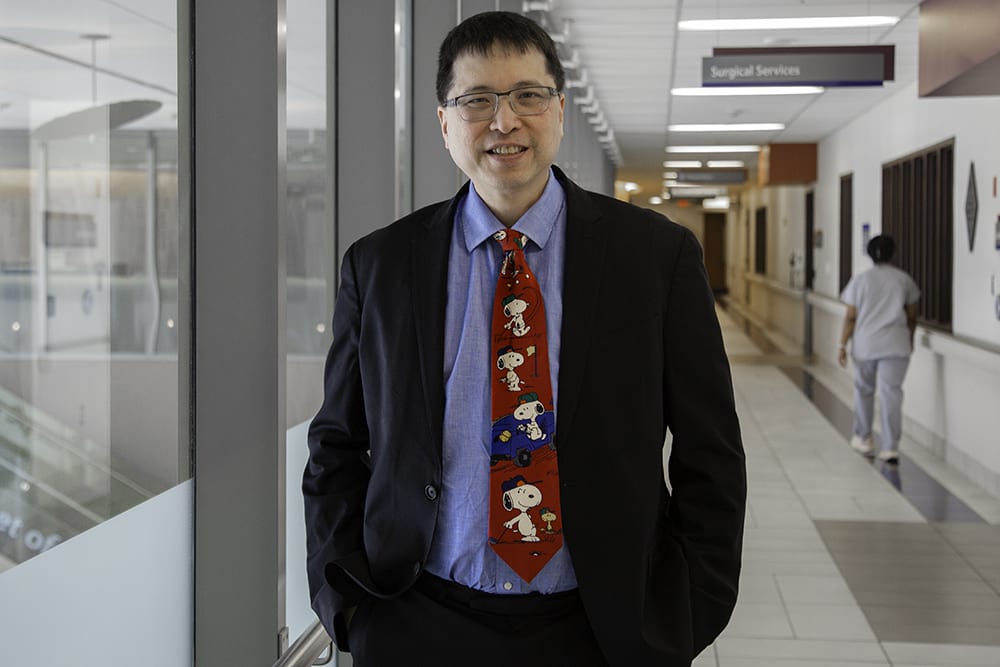
Dr. Kevin Chan noticed something was different on a recent walk through the Marotta Family Hospital Emergency Department (ED) waiting room.
Every patient had a place to sit. No one was standing or finding a spot on the floor as they waited to see a doctor. It was a visible sign of a turnaround that’s been more than a year in the making.
It started after Dr. Chan arrived at Niagara Health in February 2025 as Chief of Staff and Executive Vice-President of Medical. Since then, he’s worked with teams throughout the organization to tackle staffing shortages in key areas.
General internal medicine was one area requiring attention. Anesthesiology and emergency medicine also had glaring needs. Combined, the gaps were placing unsustainable pressures on physicians and staff that rippled throughout the hospital.
In the past year, Niagara Health has dramatically moved the needle on staffing deficits and patient experience thanks to focused recruitment and operational changes expedited by the top doc.
Back in the Marotta Family Hospital ED, initial assessment times are down about four hours this winter over last.
“Just walk through the department and compare last year to this year. It feels very different,” Dr. Chan says. “Now, when you walk through it, everyone's got a seat and a place to go.”
Strategic recruitment partnerships
Recruitment has become more targeted and deliberate in the last 13 months.
Niagara Health polished its brand to draw talent from Ontario and the northern United States. It later extended efforts to Quebec, where policy changes prompted more than 1,000 physicians to seek opportunities elsewhere.
The organization also aligned with Niagara Region physician recruitment specialist Jill Croteau, tapping into her long-standing networks and recruitment expertise in the U.K. and U.S. Building on that momentum, Niagara Health funded a dedicated position to work with the Region targeting specialty physicians.
From shortfall to stability in Anesthesiology
Some of the earliest hiring breakthroughs happened in anesthesiology, Dr. Chan notes.
The department is now fully staffed after eight full-time equivalent vacancies stymied operating room (OR) function prior to February 2025.
Today, ORs run at full capacity, eliminating surgical backlogs and stabilizing schedules across sites. Ongoing hiring will be part of succession planning as physicians retire.
Dr. Chan credits Dr. Donald DuVall, former Chief of Anesthesiology, for the recruitment successes.
“We have no gap now,” he says.
Reducing unsustainable workloads in General Internal Medicine
Physician recruitment: February to December 2025
New hires by specialty
Anesthesiology: 3Diagnostic Imaging: 2
Emergency Medicine: 3
Laboratory Medicine: 1
Medicine – Critical Care: 3
Medicine – Internal Medicine: 6
Medicine – Neurology: 1
Medicine – Hospitalist: 1
Medicine (General): 1
Obstetrics and Gynecology: 1 (physician only)
Oncology – Palliative Care: 1
Surgery – General: 1
Surgery – Ophthalmology: 1
Surgery – Orthopedic: 1
In General Internal Medicine, physicians were carrying 40 to 45 patients each – “crazy ratios” that Dr. Chan says were unsustainable.
Niagara Health has since recruited 11 physicians to the department, with about eight more in the interview pipeline. The goal is to bring patient loads closer to 30 using team-based coverage at each site, including a physician assistant or nurse practitioner.
That translates into shorter hospital stays, fewer beds occupied unnecessarily and better patient outcomes.
“If we can get ratios down, that changes how fast you can discharge patients. It also immensely improves quality of care because you have time to talk to patients and explain what we’re doing and why we’re doing it,” Dr. Chan says.
Nurse practitioners improve flow in the Emergency Department
Niagara Health added four emergency physicians in the past year, though turnover will blunt gains.
A provincewide shortage of trained physicians and too few medical students choosing the specialty contribute to the recruitment challenges in emergency medicine, Dr. Chan explains. A lack of post-graduate training capacity at Niagara Health is another hurdle.
Rather than offer debt-raising stipends to attract physicians, Niagara Health opted for operational redesign in the ED. Adding nurse practitioners at Marotta Family Hospital, who can initiate tests and assessments at triage to accelerate care before patients see a physician has been a key change.
This new model, lobbied for by the ED leadership team, has shortened length of stay and relieved crowding in waiting rooms.
“With nurse practitioners, you can do your testing up front and by the time a patient sees the doctor, they have results instead of waiting to see the doctor, getting the tests, and waiting to see the doctor again,” Dr. Chan says. “That’s a game changer.”
Plans are underway to add nurse practitioners to the Niagara Falls Hospital ED this year.
Rethinking discharge planning
Planning tweaks for patients leaving the hospital have significantly impacted departments’ abilities to better care for those being admitted.
Teams are better aligning required tests, imaging, physiotherapy and other consultations to ensure patients can leave as scheduled and earlier in the day. This frees up beds sooner, easing pressures in the ED.
“If you can discharge patients in the morning instead of discharging them in the afternoon, that enables you to admit patients from the ED sooner,” Dr. Chan says. “There’s a multiplier effect.”
