
Kidney Care and Environmental Services don’t often appear in the same story. But both departments share something in common: a strong commitment to learning how the history of Indigenous Peoples in Canada continues to shape experiences of care today.
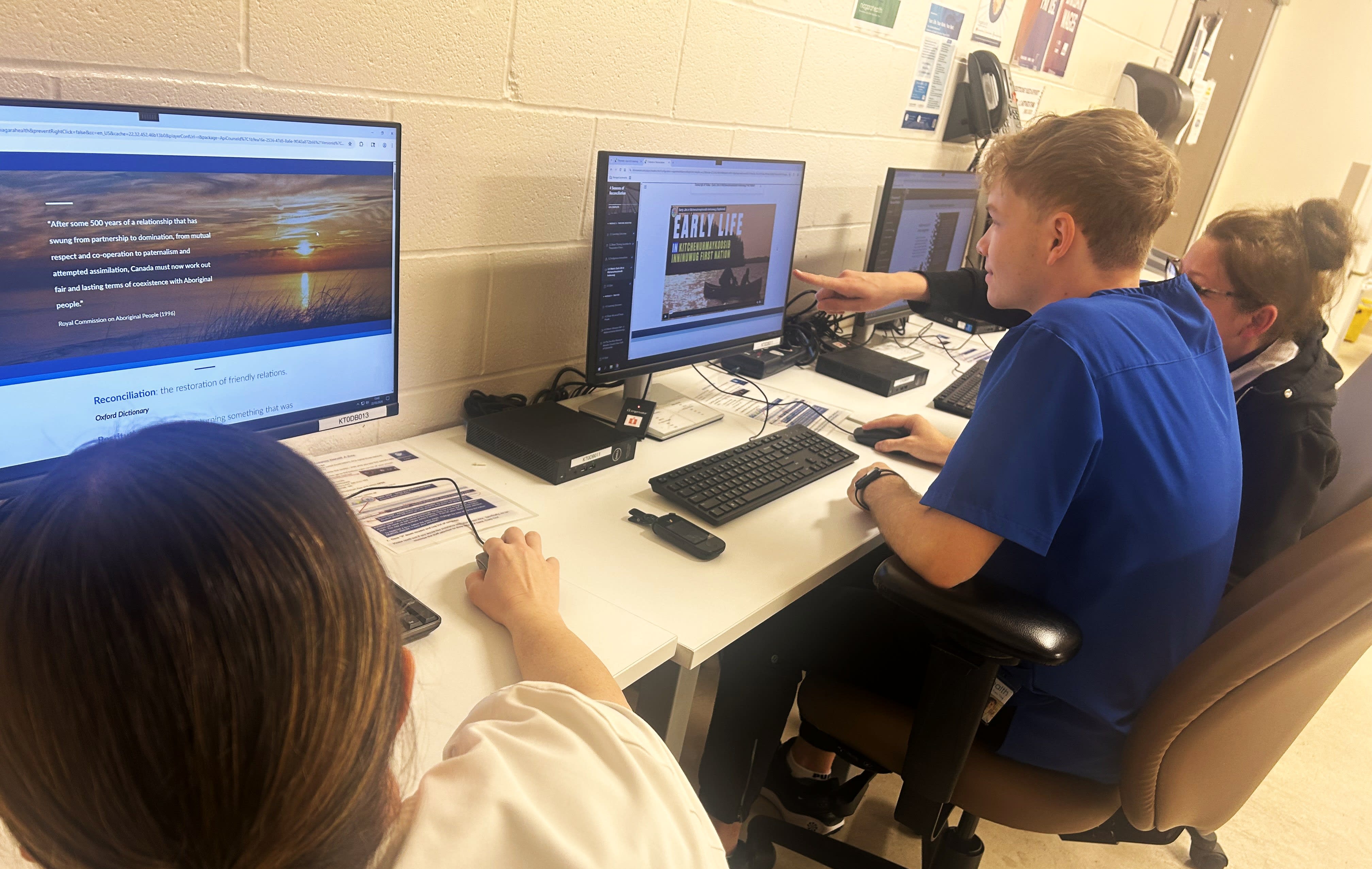
That commitment is at the heart of the Four Seasons of Reconciliation training, designed to build reflection, cultural understanding and shared learning across Niagara Health.
Staff in both departments embraced the opportunity to pause and think more deeply about how the legacy of colonization, residential schools and systemic inequities continues to influence trust, access to care and health outcomes.
“Cultural safety begins with understanding the historical trauma and systemic barriers Indigenous Peoples have faced in healthcare,” says Krystal Brant, Indigenous Relations Specialist at Niagara Health. “Every team, clinical and non-clinical, plays a role in shaping experience. The EVS and Kidney Care teams demonstrated leadership in different but equally important ways, recognizing that both informal interactions and brief, direct clinical care shape a patient's sense of safety. When care is safer for Indigenous patients, it is better for everyone.”
Learning that connects directly to patient care
For the Kidney Care team, the learning was never abstract.
The program supports many Indigenous patients, and leaders quickly recognized how the training connected directly to their work and to the care they strive to provide every day. Managers Samantha Jack and Lesley Arsenault approached the modules as part of their team’s ongoing professional development. Having completed the training themselves, they understood both the depth of the content and the space it created for reflection.
“Cultural safety begins with understanding the historical trauma and systemic barriers Indigenous Peoples have faced in healthcare... When care is safer for Indigenous patients, it is better for everyone."
As staff worked through the modules, many were most impacted by the videos — hearing Indigenous voices directly and seeing living conditions and realities that remain part of life in Canada today. During breaks and in-between patient care activities, members of the Kidney Care team used available time on their WOWs to complete sections of the training, intentionally building the learning into their day.
“For me, the video spoke most,” Arsenault said. “Knowing that that’s going on right here in our own country was mind blowing.”
The learning prompted reflection on communication, including how assumptions and unconscious bias can shape interactions. That reflection resonated across a diverse team.
Silla Sabu, a nurse who immigrated to Canada from India 10 years ago, shared that while she had previously learned about Indigenous history, the Four Seasons of Reconciliation training stood out.
“With this particular Four Seasons module, it was very thoughtfully put together,” she said. “The videos made it feel like the individuals were speaking directly to me.”
She added that while history can be taught in many ways, the way the stories and perspectives were presented left a lasting impression.
“You can learn history in different settings,” she said. “But this training stayed with me in a different way.”
In a dialysis setting, where relationships develop over time and trust is essential, reflection felt especially relevant.
“It was deeply moving,” Arsenault said. “I found myself thinking about things many weeks after… you digest it very slowly.”
Leaders noticed the learning showing up not only in conversation, but in approach.
"It was deeply moving. I found myself thinking about things many weeks after."
“There’s something you do a little differently,” Jack reflected. “You’re more inviting, more attentive and you ask more questions.”
For Environmental Services (EVS), access looked different.
Staff work across multiple sites and shifts, and many team members do not regularly use computers as part of their workday. Recognizing that early, leaders focused on making the training accessible.
Small group sessions were organized in ICT training rooms, libraries and shared spaces across sites. Additional coverage was arranged so staff could step away from their duties and engage fully with the material.
Leaders encouraged staff to take the time they needed, whether completing the modules in one sitting or working through them in sections.
“I just wanted everybody to experience it,” said Lisa Beckett, EVS Supervisor. “Once people started, word got around.”
As staff moved through the training, the response was immediate and, for many, emotional. Several shared that they were surprised by how much of the history — and its ongoing impacts — they had not fully understood, including the lasting effects of residential schools and the inequities many Indigenous communities continue to face.
“People were shocked,” said Kevin Traynor, Director of Environmental Services. “They couldn’t believe some of what they were seeing — especially that these realities are still happening today.”
Completing the training together created space for conversation. Group settings allowed staff to pause, reflect and talk through what they were learning.
“It was a lot to take in,” said EVS Supervisor Shannon Cain. “But it stayed with people.”
Leaders observed that once staff engaged with the material, hesitation faded. Questions shifted from why it needed to be done to when and how others could take part.”
“People started coming in asking when their training was,” Traynor said. “They wanted to do it.”
