
This is an opinion column by Niagara Health Communications Specialist Tiffany Mayer, published in the St. Catharines Standard, Niagara Falls Review and Welland Tribune.
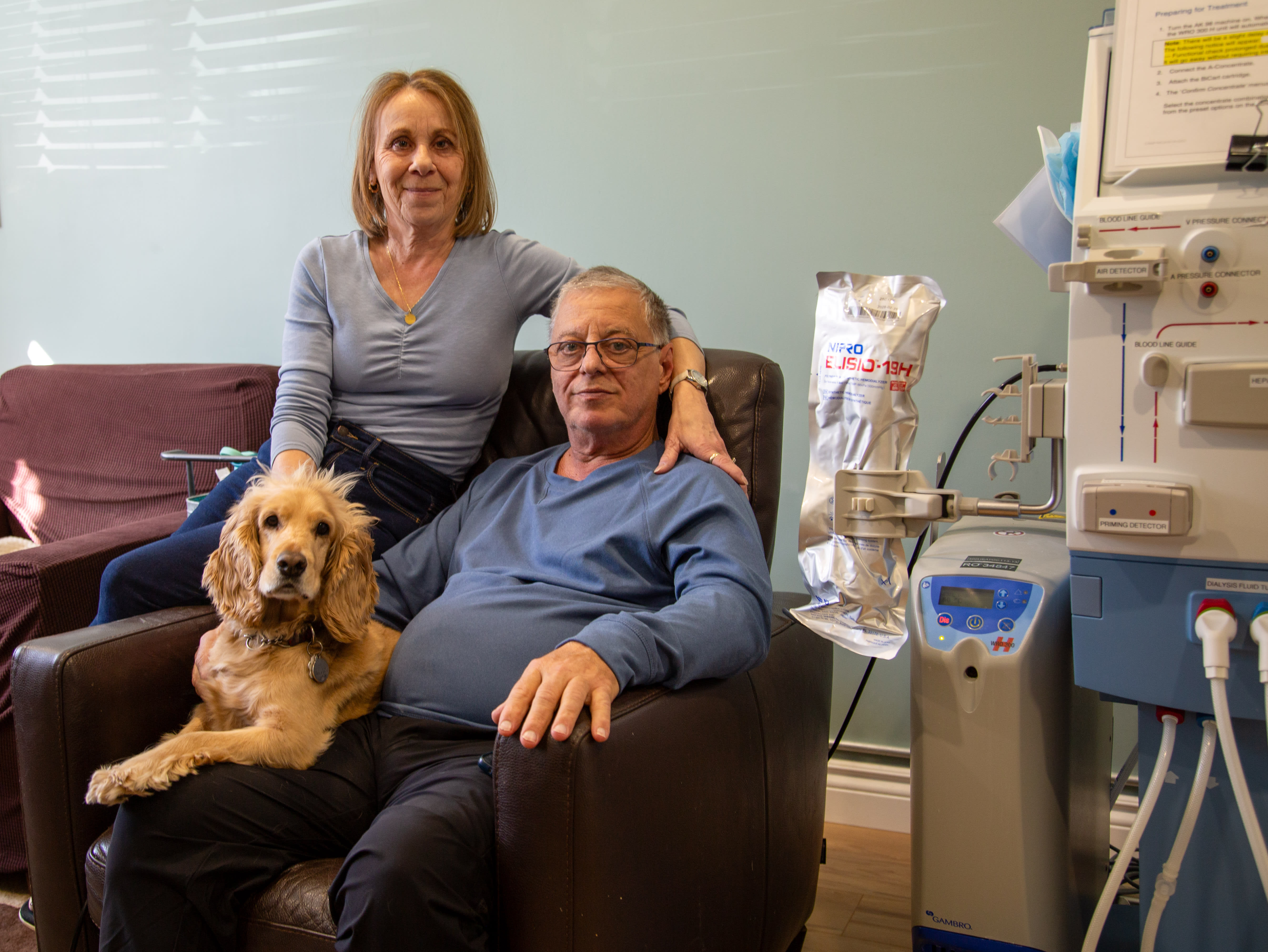
There’s a good chance when Angelo Melaragni does his next hemodialysis treatment, he’ll flip on his turntable and listen to a favourite from his extensive vinyl collection.
His cocker spaniel mix, Kyro, will usually find his spot in the chair next to Melaragni for three to four hours while the hemodialysis machine does duty for the Welland man’s kidneys, removing the waste and fluids that his failing organs can’t.
If the forecast is good, sunlight might spill into the room, adding to the warm feel. And Melaragni’s wife, Cathy, will take a seat next to him – maybe with a cookbook so the couple can plan their dinner – after checking his vitals and getting him settled in for treatment.
None of this would happen if Melaragni opted to do hemodialysis in a hospital. But as a home hemodialysis patient with Niagara Health, he undergoes the physically taxing process when it best suits the couple, surrounded by creature comforts in his favourite room in the house.
“I call it my man cave,” Melaragni says. “I’ve gotten really used to being in here. I’m at home, in the comfort of my home and I get to dialyze on my schedule.”
Melaragni is one of 20 Niagara Health patients doing home hemodialysis, says Leigh-Anne MacDonald, one of two registered nurses supporting the program.
The numbers drop as patients get transplants and no longer need the regular treatment that keeps them alive until then. With all the benefits of doing hemodialysis at home, MacDonald hopes to see more patients waiting for a new kidney give it a try.
“It’s such an amazing thing,” MacDonald says. “Doing a dialysis treatment is like running a marathon. It’s exhausting. But if you can do it gently every day or every other day at home, it’s easier on patients.”
“Doing a dialysis treatment is like running a marathon. It’s exhausting. But if you can do it gently every day or every other day at home, it’s easier on patients.”
Melaragni, who has polycystic kidney disease (PKD), is a new recruit to Niagara Health’s home hemodialysis program. Until earlier this winter, the retired chemist had done peritoneal dialysis, another home-based treatment for kidney failure in which fluids and toxins are flushed from the body using a catheter in his abdomen.
But after three and a half years, it was no longer enough to provide the quality of life he was used to. His routine hikes had to be abandoned. Even walking around the block with Cathy and Kyro became too hard.
“I felt like a zombie,” Melaragni recalls. “I couldn’t do anything.”
“He had days where we thought, ‘Oh, he’s doing better,’” Cathy adds. “But when you look back, you see he wasn’t.”
Hemodialysis was the critical next step in his survival until a kidney transplant. If he did the treatments in hospital, it would have meant a fixed schedule of four-hour sessions, three times a week with limited flexibility.
Rain, shine or blizzard, Melaragni’s life literally would have depended on showing up on time no matter what life or the forecast threw at him.
When his nephrologist, Dr. Danny Lagrotteria, told him he’d be a good candidate for home hemodialysis, he was open to exploring it. His father, who also had PKD, did hemodialysis at home, but the couple wasn’t aware it was still a treatment option.
To prepare, the Melaragnis had to modify a spare bedroom so it could handle the required water flow and power load to run the machine that removes his blood for cleaning and then returns it. Grants from the Ontario Renal Network cover their increased utility costs, and all other equipment needed for treatment is provided.
They also underwent several weeks of training at the Niagara Falls Dialysis Clinic and Training Centre to confidently use the hemodialysis machine and troubleshoot any issues. That experience confirmed their decision.
“They’re very busy. When I was there for my hemodialysis sessions, I couldn’t believe how many people were there getting treatment,” Melaragni recalls. “There were alarms going off, needing nurses’ attention. Someone needs to be taken off a machine. Someone needs to be put on. They work hard there.”
After training, one of the nurses stayed with the couple for the entire day of their first treatment at home, tapering off their oversight over the next two sessions. Cathy, who checks her husband’s vitals and keeps an eye on him during treatment, took on the role of “Nurse Cathy” alongside her role as a wife. But MacDonald and fellow home hemodialysis nurse Bob Kubushesky are always within reach if any issues arise.
Since starting home hemodialysis, the couple have noticed a marked improvement in Malagragni’s health. He’s walking with ease again and losing weight. When the weather changes for the better, they’ll dialyze in the evenings instead and spend their days outdoors.
The list of home hemodialysis benefits seems countless to MacDonald. From adapting manuals and materials to help a caregiver who is legally blind to enabling patients with demanding schedules to dialyze while they sleep, there are few reasons why someone couldn’t do it, she says.
Even people without a caregiver can be matched with a PSW from St. Elizabeth Healthcare to oversee their treatments at home.
“A lot of people think ‘I wouldn’t be able to do that’ but we’ve adapted things to help patients. We make it simple for them, and we teach until they know they can follow every single step,” MacDonald says. “Anybody can do this as long they have an appropriate home where we can set up the plumbing and electrical for them.
“There really is no reason they can’t be home. Plus, there are so many advantages to being home, why wouldn’t you want to be?”
