
Niagara Health is helping expand access to life-saving heart transplants, thanks to new equipment made available by the Trillium Gift of Life Network (TGLN).
Known as “heart in a box” technology, the TransMedics Organ Care System (OCS) Heart revives donor hearts that have stopped beating after circulatory death. It keeps them beating outside the body and enables them to be transported at near-body temperature.
Surgeons can also assess and continuously monitor how the donor heart functions in real-time before transplanting it.
Thanks to this technology, which TGLN acquired last fall to share with Ontario hospitals, including Niagara Health, the heart donor pool is expected to increase by 30 per cent.
At the end of 2024, 155 adults and 29 children were on Canada’s heart transplant wait-list, according to the Canadian Institute for Health Information. Heart failure remains a leading cause of hospitalization and death nationally.
“This system will expand donor capacity significantly,” says Steven Walker, Marotta Family Hospital Operating Room Clinical Manager. “It’s increasing accessibility and providing hope for the donation program.”
“I’ve seen a lot of different surgeries, but this is truly one of the most amazing I’ve seen.”
Previously, hearts that stopped beating because of circulatory death were often unsuitable for donation and transplant because of a lack of oxygen. That limited the pool of donor hearts to those offered after neurological death only.
But those donor hearts also came with their own challenges because it was impossible to see how they functioned after retrieval. The window for transplantation was also narrower – about three to four hours – in part because donor hearts had to be transported on ice.
The OCS Heart extends transportation time to about 12 hours, meaning donor hearts can reach recipients farther away from where they are retrieved. Niagara Health’s Heart Investigation Unit performs cardiac catheterizations to ensure the organ’s health before being transplanted.
The first heart transplant after circulatory death in Canada was performed last fall at University Health Network’s Toronto General Hospital. It came six years after the first such transplant ever in 2019 in Massachusetts.
Although TGLN can’t provide precise numbers, Niagara Health has been able to retrieve “a few” donor hearts since September thanks to the OSC Heart. Each year, Niagara Health supports between nine and 19 organ and tissue donors.
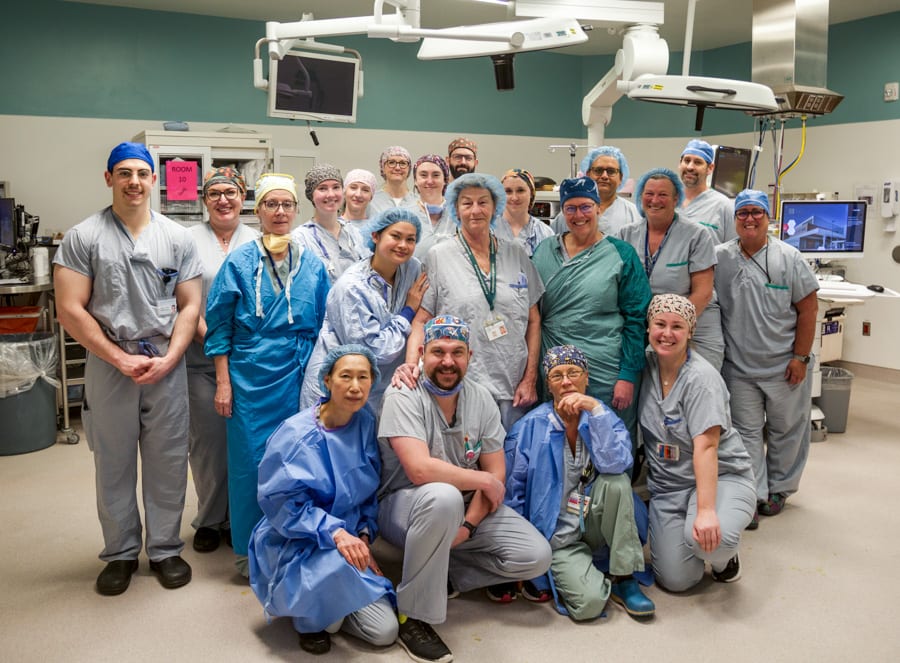
The key to Niagara Health’s successful contributions comes down to Walker’s OR team being able to pivot and work quickly when a donor heart or other organs becomes available.
The donation process
Once a patient has been identified as a donor candidate, TGLN approaches the family to discuss wishes and consent.
It can be a difficult decision – one that often impacts a family’s grieving process – but many consent because they understand the impact, Walker explains.
“The TGLN team does an amazing job of supporting families, which turns a tragic outcome into something that helps a family find peace at the end of a patient’s journey,” he says.
Next, it’s a matter of co-ordinating multiple teams under tight timelines. Sometimes, scheduled procedures need to be bumped to free up an OR. The OR team then works alongside a retrieval team that comes from outside of Niagara Health. Depending on the organs being donated, the process can take between two to six hours.
Did you know?
Niagara Health was once again recognized provincially for supporting organ and tissue donation as part of compassionate, end-of-life care.
Last fall, the hospital was presented with a Hospital Achievement Award for Provincial Conversion Rate. The Hospital Achievement Awards, presented by Trillium Gift of Life Network, recognize hospital partners that meet or exceed provincial targets in key areas of the donation process.
The conversion rate is the percentage of potential organ donors who went on to become actual donors. This is the sixth year in a row Niagara Health has earned the honour.
Meanwhile, recipient teams wait at the ready at their respective hospitals. Ontario Provincial Police are on standby outside Niagara Health sites to transport organs with lights and sirens.
“It’s co-ordinating those specifics of getting the patient into the OR and co-ordinating with the OPP that these kidneys are going with these officers and this liver is going with these,” Walker says. “When you talk about the actual mechanics of what TGLN does, it really is amazing work.”
And it wouldn’t happen without a strong OR team that often works outside of regular hours to retrieve organs and minimize the impact on scheduled surgeries, he adds.
“I’m very fortunate. I have a great team and a great charge nurse that does the work of co-ordinating. These are difficult cases. The stress is on them to do the retrieval, which is not easy,” Walker says.
“It’s difficult on our team. They’ve had young patients, who have lost their lives and become donors,” he adds. “They’re used to saving lives and we try to reiterate that we are in these cases, but they are seeing just one stage.”
To help the OR team process these experiences, Walker often talks about the outcomes of transplants using the organs.
The impact isn’t lost on anyone, including those donations requiring use of the OCS Heart, he notes.
“I’ve seen a lot of different surgeries, but this is truly one of the most amazing I’ve seen.”
