
This is an opinion column by Niagara Health Communications Specialist Tiffany Mayer, published in the St. Catharines Standard, Niagara Falls Review and Welland Tribune.
Erika Reece didn’t pose with a giant cheque when she says she won the lottery, but the Fort Erie woman did gain back her life.
Reece’s big win was a new kidney from a living donor she doesn’t know. It was a match with a two per cent chance of happening and far greater odds of an indefinite wait for a life-changing transplant.
“It was astronomical that we found each other,” said Reece, 56. “My hat’s off to the people who do these pairings.”
It was spring 2022. Reece was a busy mom to two adult sons and a young daughter and worked as a superintendent with the Canada Border Services Agency when she got sick with COVID-19.
By June, she was certain she was over the worst of her infection even though her eyes were inflamed and she had a bad cough. That’s when her eye doctor gave her some unexpected advice: get a blood test.
She did, and that led to another out-of-the-ordinary experience. Reece’s family doctor showed up at her door after her results showed dangerously high levels of creatinine. He told her get to a hospital immediately.
Reece was experiencing Stage 4 kidney failure.
Five days and several tests later, she learned from Niagara Health nephrologist Dr. Kathleen Quinn that she had one of the most serious autoimmune disorders, C-ANCA vasculitis, which affects the upper respiratory tract and kidneys.
“It’s a sneaky one because it disguises itself as a respiratory illness,” Reece said. “But the shortness of breath and the brain fog I felt was my kidneys.”
Within two weeks of that initial bloodwork revealing a serious issue, Reece began dialysis. She also did b-cell depletion therapy at the Walker Family Cancer Centre to help her immune system reset and reduce the antibodies attacking her body.
“I was healthy and working out in May and I felt like I was on death’s door by mid-July. It was very traumatic,” she recalled. “I couldn’t walk. My eyes were sensitive to light, so I was always wearing sunglasses. At this point, I knew I was going to live, just on dialysis.”
Reece’s care needs eventually led her to St. Joseph’s Healthcare in Hamilton, where she underwent a blood-filtering treatment for her vasculitis in hopes her kidney function would return to normal.
But after seven months, her doctor there told her she would likely need a kidney transplant. Reece wasn’t ready to discuss it.
"I received a life-saving gift from my sister and my paired donor that gave me a second chance at life. I wish more people realized how many people are waiting for a kidney and that they can donate and live a totally normal life."
Finding a kidney donor
Those first few months after she got sick took a serious emotional toll. Then something in her shifted. She forced herself to get out of bed and rebuild the strength and cardio capacity she lost. She returned to work, doing her job at home like so many others at the height of the pandemic.
The following year, she transitioned from hemodialysis to peritoneal dialysis, a more flexible treatment for kidney failure that can be done at home.
Reece got into a better headspace about her future.
“By this point, I was starting to think about a transplant. I said to my doctor ‘OK, we can talk about it for five minutes,’” she said. “I wanted to have an active life and I know on dialysis, the clock is ticking.”
Reece was put on the wait-list for a deceased donor – a process that typically takes three to six years, according to the Trillium Gift of Life Network. She also looked to the kidney paired donation program, an interprovincial organ-sharing program for living donors operated by Canadian Blood Services.
People close to Reece offered one of their kidneys. Sixteen friends and family stepped up but none matched her blood type. Her sister, whose blood type was also incompatible, put forward her kidney in hopes the genetic similarity between the two women would make it work.
But by summer 2024, that option was off the table, Reece recalled, because her antibodies would likely cause her body to reject it. Instead, her sister donated her kidney to another recipient in the kidney paired donation program, which kept Reece on the list.
Reece was left with a two per cent chance of finding a living donor. And yet, that October she got a call that an anonymous donor had been found through the kidney paired donation program. Reece had her transplant at St. Joseph’s on Jan. 31, 2025.
“I’d never had major surgery in my life, so I was really scared about getting put under, but I had no choice,” she said. “This was what I had to do to have a full life.”
When she woke up after the three-hour transplant, she told the nurses she wanted to eat a fast-food breakfast sandwich, sushi and a submarine sandwich – all the foods she couldn’t have while doing dialysis because they’re high in sodium.
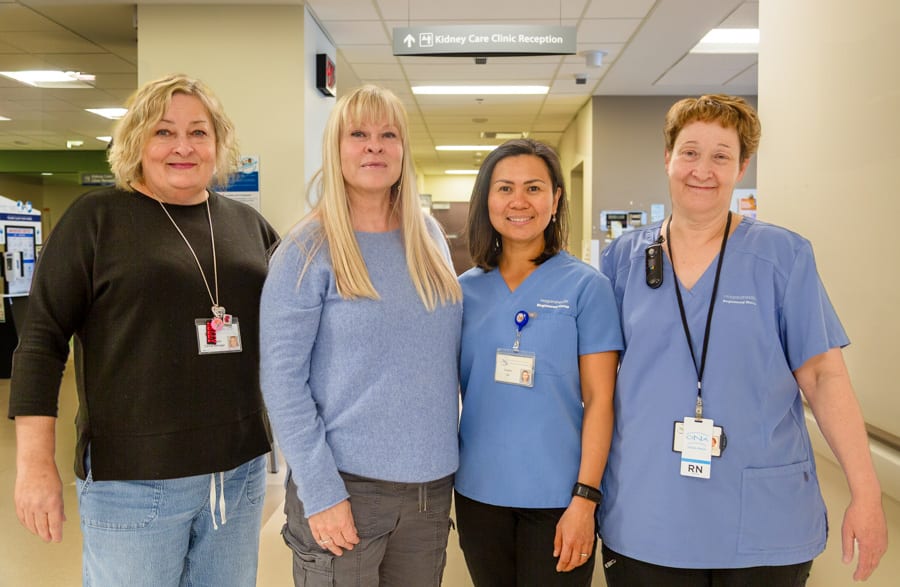
This past January, Reece celebrated one year with her new kidney by taking a cruise a with her husband, Mike. Since her transplant, she’s started speaking with patients receiving kidney treatment at Niagara Health about her experience and her gratitude for the hospital’s kidney care program.
She also advocates for the paired donation program with hopes of recruiting more living donors.
“I feel amazing,” Reece said. “I have scars on my stomach and have to take (anti-rejection) medication, but I can get up and go to sleep whenever I want; eat or drink whatever I want. I’m able to work. I don’t get tired. I received a life-saving gift from my sister and my paired donor that gave me a second chance at life.
“I wish more people realized how many people are waiting for a kidney and that they can donate and live a totally normal life.”
