
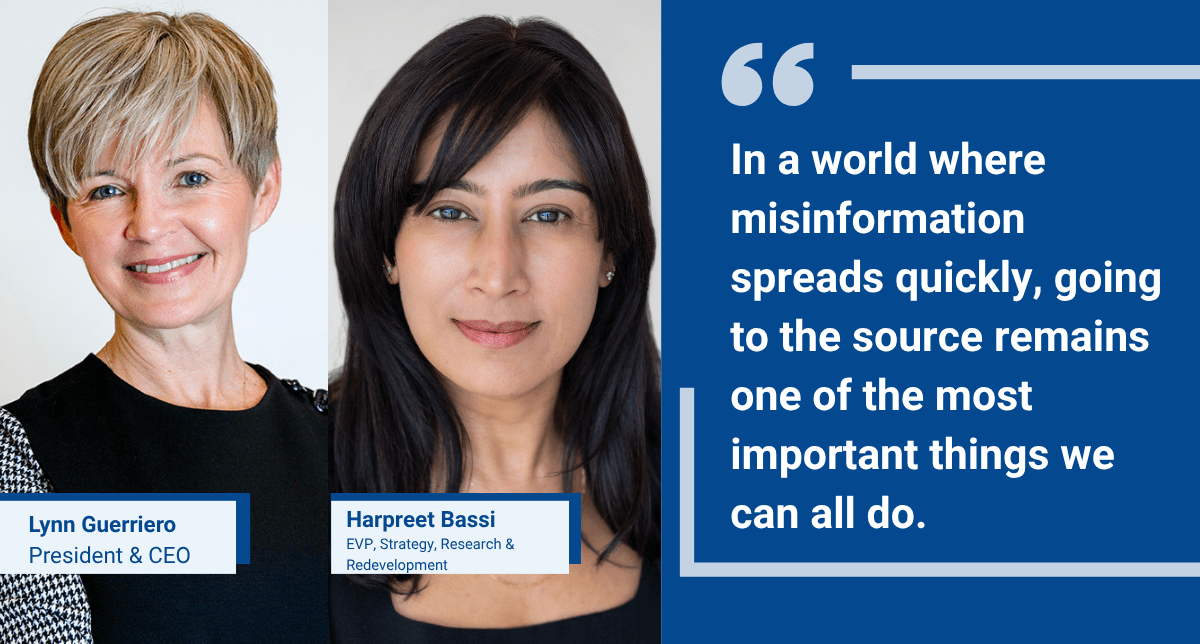
This is an opinion column by Niagara Health President and CEO Lynn Guerriero and Executive Vice-President, Strategy, Research and Development Harpreet Bassi, originally published in the Niagara dailies.
Healthcare is personal. Most of us only interact with the hospital system when something serious is happening in our lives or in the lives of people we love. That makes the information we rely on especially important.
Today, a lot of that information comes through social media. Posts are shared quickly, often stripped of context and amplified by emotion. A single claim can be repeated hundreds of times before anyone pauses to ask whether it is accurate. When the topic is healthcare, that speed can create real confusion and unnecessary fear.
At Niagara Health, we see this play out in real time. Claims that services are “being shut down,” care is being reduced or that people have nowhere to go in an emergency can spread quickly and create fear.
That is why it matters to slow the conversation down and return to the facts.
Niagara Health is not retreating. We are transforming care to meet the needs of today and the future. That includes the new South Niagara Hospital, now under construction, which will be a modern, state‑of‑the‑art facility designed to provide the care people need today. Alongside it, our Welland and St. Catharines hospitals will continue to play clear and essential roles. Together, they form a three‑site model that will allow specialized teams to focus their expertise and provide safer, more coordinated care.
This approach is about increasing and strengthening services. Specialization helps reduce cancellations, improves patient flow and supports better outcomes for people needing both same‑day procedures and more complex care. These changes are grounded in evidence and shaped by years of planning, clinical input, community engagement and backed by data.
Transformation, however, can be misunderstood online. Social media often flattens complex decisions into simple narratives of loss or decline. Plans that are about investment can be framed as abandonment. That is how misinformation takes root.
In healthcare, misinformation is not just unhelpful. It can be dangerous. Inaccurate claims about emergency departments or exaggerated wait times can discourage people from seeking care when they need it. They can make someone second‑guess whether it is ‘worth going in’ or assume help is unavailable when it is not. That is why accuracy matters so much when talking about hospitals and access to care.
This is not to say our system is without challenges. Demand is high. Staffing shortages are real. Patients experience delays and frustration, and we hear that directly. Those realities deserve honest discussion and accountability. They deserve solutions rooted in evidence, not speculation shared online without context.
At Niagara Health, we believe transparency is an important responsibility. We openly share information about service changes, planning decisions, workforce initiatives and major investments. When information circulating on social media is inaccurate, we work to correct it.
We believe people in Niagara deserve accurate, reliable information about their healthcare system. That responsibility does not sit with one organization alone. It is shared by all of us who have leadership roles in the community, regardless of title or position. Niagara Health welcomes constructive debate about health policy and how care is delivered, and reasonable people can disagree. But those conversations must be grounded in facts, not speculation or misinformation shared online. We all have a responsibility to be truthful about how hospitals work, what services are available and what the data actually shows, including around emergency department wait times and clinical outcomes, because accuracy is essential to public confidence and patient safety.
In a crowded online environment, truth can be difficult to discern. Our website and official social media channels provide current, verified information. They are accountable. They exist to help people make informed decisions.
Our staff and physicians continue to show up every day, caring for people under extraordinary pressure and with deep commitment to this community.
Healthcare works best when communities and hospitals trust each other. Facts, compassion and openness are how that trust is built. In a world where misinformation spreads quickly, going to the source remains one of the most important things we can all do.
