
This is an opinion column by Head of Service for Geriatrics Dr. Ziyaad Al-Khateeb, originally published in the Niagara dailies.
Niagara is getting older. That is not a projection or a planning assumption — it is the reality we see every day in our hospitals.
I’ve been a geriatrician at Niagara Health for the past 10 years, starting my career here after completing my training. I was drawn to geriatrics because of its holistic approach to care, and the opportunity to support an older population that is often underserved. My clinical focus is on dementia and behavioural symptoms — conditions that are becoming more common as our population ages.
Niagara has one of the highest proportions of older adults in the country, and that is expected to continue to grow. At the same time, our population has higher rates of chronic disease than the provincial average. The most common conditions we see, such as heart disease, chronic respiratory disease, diabetes and stroke, are closely tied to aging. We are also seeing increases in conditions like Alzheimer’s disease and other forms of dementia.
This changes what good care needs to address.
Caring for older adults means managing multiple conditions at once, while also focusing on function, independence and recovery.
At Niagara Health, this shift is already well underway.
Across our sites, teams are adapting how care is delivered. In our Emergency Departments, this can mean specialized geriatric assessment and a greater focus on avoiding admissions where appropriate. On inpatient units, it includes preventing complications such as delirium, reducing falls and maintaining mobility so patients can return home safely. In outpatient settings, it means more coordinated follow-up and support for managing complex conditions over time.
This work is not always visible, but it is critical.
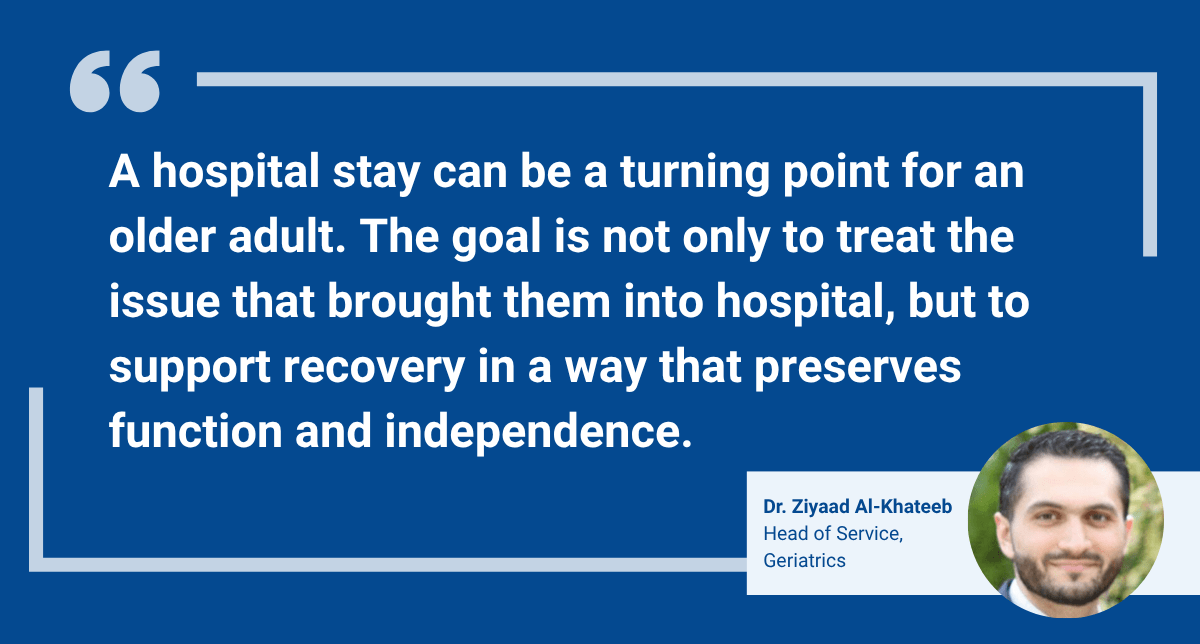
A hospital stay can be a turning point for an older adult. The goal is not only to treat the issue that brought them into hospital, but to support recovery in a way that preserves function and independence. That requires coordination across teams, and a more deliberate approach to how care is planned and delivered.
It also depends on what happens outside the hospital.
Older adults rely on a combination of hospital care, primary care, home care and support from caregivers. When these connections work well, patients are more likely to move safely through the system and return home. When they do not, the strain is felt quickly — often in Emergency Departments and inpatient units.
This is why Niagara Health is focused on building a more coordinated approach to care for older adults.
The new South Niagara Hospital is a key part of that work.
It is being designed as an older persons-focused hospital, shaped by the needs we see across the region. That includes more than 160 design requirements aimed at creating a senior-friendly environment — from lighting and flooring to handrails, signage and the layout of spaces. These features are not cosmetic. They directly affect safety, mobility and how patients and families experience care.
This physical design supports a broader model that will become Niagara Health’s Centre of Excellence for Wellness in Aging.
While the Centre will be based at South Niagara, it reflects a system-wide approach. The goal is to bring together existing programs, expertise and partnerships into a more consistent model of care across all sites.
An older adult who arrives at any Niagara Health hospital should experience the same approach — whether that is how risks are identified, how complications are prevented, how caregivers are involved or how discharge is planned.
We are not starting from scratch. Many of these elements are already in place. The work now is to strengthen how they connect and how consistently they are applied.
Seniors’ Month is a time to recognize the role older adults play in our communities. It is also an opportunity to reflect on what an aging population means for the healthcare system.
For Niagara Health, it means continuing to adapt.
It means building on the expertise that already exists across our teams. It means designing care with the needs of older adults in mind from the outset. And it means working more closely with partners across the system to ensure patients are supported beyond their hospital stay.
This is ongoing work.
And in a region like Niagara, it is essential.
