
We are Niagara Health is a series of stories that celebrates the incredible people working and volunteering in our organization and how they make a difference in the lives of patients and coworkers every day.
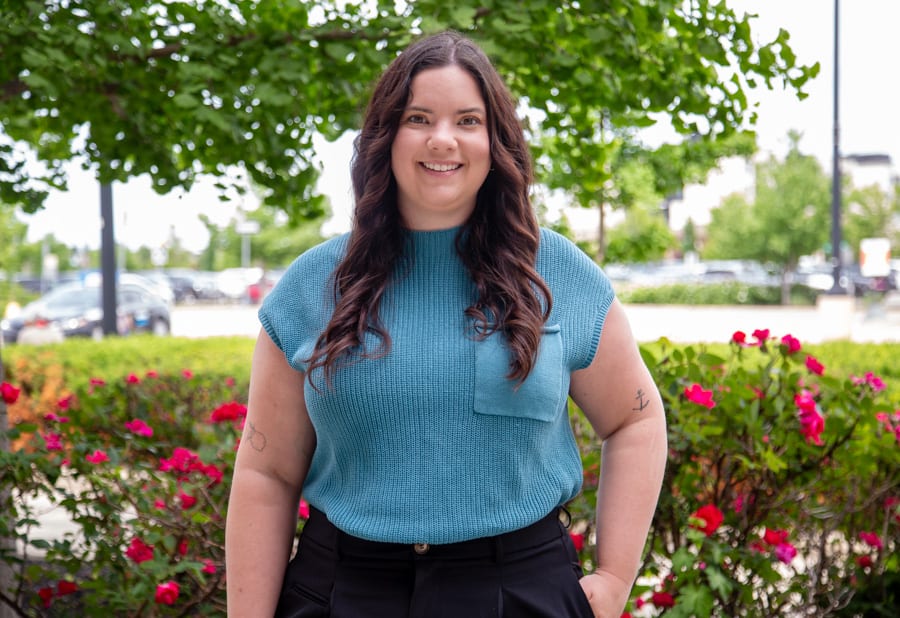
Kiersten Vaananen fielded a lot of questions the first time she decorated the Neonatal Intensive Care Unit (NICU) for Pride Month.
To help families get to know the NICU team, staff names are displayed on colourful foam shapes along a feature wall. It changes throughout the year to reflect seasons, celebrations and awareness months, including in June when names appear on rainbow hearts for Pride.
“At first, it was, ‘Why are you doing that?’” Vaananen recalls. “Some didn’t want their names up.”
These days, the registered nurse – who’s also the unit’s go-to decorator for holidays and events – still gets questions during Pride Month. But they sound much different from just a few years ago.
“Now people are excited to have their names up and ask if they can make new shapes or if they can help,” Vaananen says.
That change is a testament to Vaananen’s efforts to create an inclusive space in the NICU, where, until recently, the gender binary was often assumed. Shifting beyond that mindset was as important to her as it was to gender- and sexually diverse parents welcoming babies.
As a member of the 2SLGBTQIA+ community, Vaananen needed to live authentically in every part of her life, including at work, where she met her partner, Kayleigh Tyrer, Clinical Manager of Addiction Services.
“I found it hard when I started to come out,” she says. “Slowly, as I gained people’s trust and respect, I said, ‘If this is going to become my home, I need to be myself.’”
Vaananen’s work to shift the culture over her seven years with Niagara Health goes beyond decorating for an annual recognition event. When caring for same-sex couples, she asks both parents how they want to be involved in their baby’s care. She also learns their pronouns and how they want to be addressed, modelling that approach for her coworkers.
“Just because they’re not your traditional mom and dad and baby, they’re a family,” she says.
“If we have the Pride flag up, have stickers and are having the conversation of ‘What do you want to be called? What role do you want to play?’ it creates a safe space for people to be themselves.”
Advocating for patients who can’t speak for themselves comes naturally to Vaananen. It’s what drew her to working in the NICU while completing her nursing bridging program in her hometown of North Bay. She did a brief placement at Niagara Health’s NICU and was certain after one shift that she wanted to transition from working with older adults in long-term care, where she was previously, to caring for a health system’s youngest patients.
“I like that the babies can’t tell you what’s wrong. You really have to use critical thinking to figure it out,” Vaananen explains. “I like going to deliveries and seeing the babies fresh out of the womb and taking their first breath. I like being there for families and telling them everything is going to be OK. There are tough times as well, but 98 per cent of the time, it’s a good thing.”
Her impact is most evident in how safe patients feel on the unit. They notice the inclusive environment immediately, and that shapes their care experience.
Vaanen recalls two fathers from France who welcomed their children through surrogacy in Canada. Both their children spent time in the NICU.
“People were so excited to have them back when their second child was born and have them involved,” she says. “We got team stars from them, which was really meaningful.”
Broader policy changes have helped, too, Vaananen says. For example, Niagara Health replaced the ‘Mother’s Name’ field on crib cards with the more inclusive ‘Parent’s Name.’
“That’s huge. I feel happy and proud. I don’t feel scared to be myself,” she says.
Education is one of the most meaningful ways to support the 2SLGBTQIA+ community, Vaananen notes. Small, thoughtful actions can also make a difference, from planting a Pride flag in home gardens to adding a sticker to a water bottle or wearing a pronoun pin.
“Traditionally, the community would be scared or avoid the healthcare system for fear of being misgendered or misunderstood,” Vaananen says. “If we have the Pride flag up, have stickers and are having the conversation of ‘What do you want to be called? What role do you want to play?’ it creates a safe space for people to be themselves.”
