
Every physician needs compassion, empathy and strong communication to do their job.
As the population ages, however, Dr. Samuel Thrall says there’s another quality doctors must have: knowing how to care well for older adults.
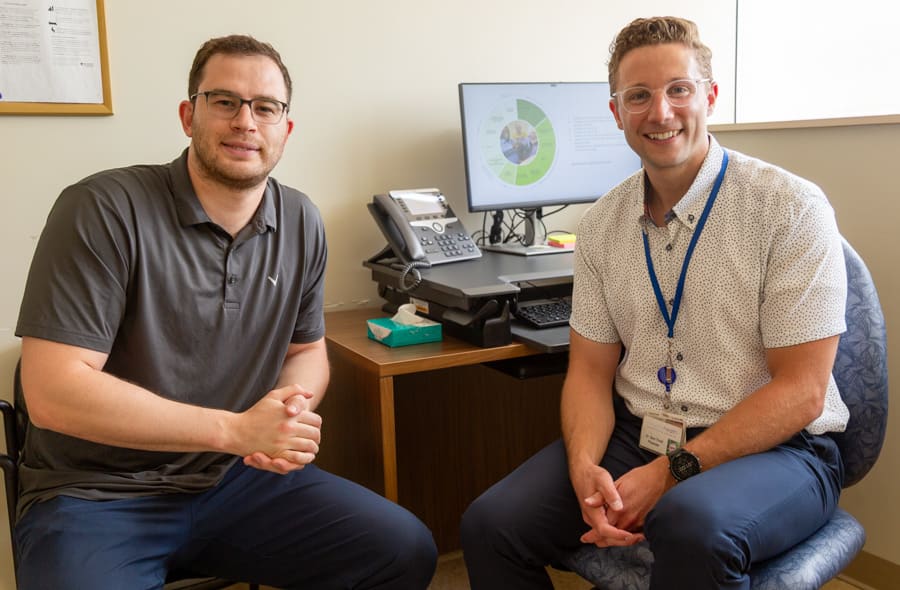
It’s a skill the Niagara Health geriatrician is looking to pass on. As site co-ordinator for geriatric medicine education at the Niagara Regional Campus (NRC) of McMaster University’s Michael G. DeGroote School of Medicine, Dr. Thrall is teaching the next generation of doctors how to provide age-friendly care, even if they don’t plan to become geriatricians.
“Geriatrics, I would argue, is really the bread and butter of what a health system does. This is the main clientele, the main source of business for any health system,” Dr. Thrall says. “Medical education as a whole is starting to realize every future physician, no matter their discipline, will have to care well for older adults.”
Niagara is a prime training ground for physicians looking to develop age-friendly care practices. More than 45 per cent of the region’s population is over the age of 50, according to census data. That’s one of the largest older adult populations per capita in Canada.
At the hospital level, more than half of acute-care patients at Niagara Health are 65 or older. Demand for hospital care for older adults is expected to increase by 18 per cent over the next 10 years.
Working with McMaster and Niagara Health teams, Dr. Thrall is growing the opportunities to teach evidence-based care for older adults. Those efforts are attracting physicians from across Canada for specialized training.
"We are all united in our mission to train and raise up the next generation and help them provide care for older adults."
Last year, he helped establish a new fellowship focused on falls and frailty, tapping into local and regional expertise in orthogeriatrics, which combines orthopedic surgery with geriatric medicine to care for older patients with complex fractures.
The one-year program welcomed its first trainee – a resident from McGill University – last September.
A separate year-long certificate program developed in collaboration with Dr. Emily Wilson, postgraduate liaison for care of the elderly at the NRC, offers experience in long-term care, memory clinics, palliative care and research. It includes three months of training with the Niagara Health Geriatrics program. The most recent trainee plans to apply those skills to a family physician role in long-term care.
“It’s a comprehensive program to give training in older adult care in all the ways a family doctor might provide care,” Dr. Thrall explains. “We’re trying to teach them that specialist-level knowledge – to be as precise as possible in diagnosis and to provide a goal-aligned care plan that helps patients and families plan for the future.”
Niagara Health’s Geriatrics team, which also includes geriatricians Dr. Ziyaad Al-Khateeb and Dr. Lindsay Schnarr, hosts visiting fellows as well. The most recent was from British Columbia.
This builds on geriatric education programming that already existed, including a renowned geriatrics program offered by McMaster and training in older adult care for every family medicine resident in Niagara.
“We’re seeing medical students coming to us because no matter whether you go into psychiatry, general internal medicine or neurology, you need to know how to care for older adults,” Dr. Thrall says.
The Geriatrics portfolio at Niagara Health is also robust with unique programs to learn from, including the orthogeriatric consultation service. Run by Nurse Practitioner Christina Huntington, the service provides specialized assessment and treatment for patients 80 and older with hip fractures, with the aim of shortening hospital stays and helping patients return safely to their normal lives.
“We’re leveraging some of our expertise in Niagara with that program,” Dr. Thrall says. “We are all united in our mission to train and raise up the next generation and help them provide care for older adults. When I look at our team, including our manager, Stefanie Irish, and Director Lori MacCulloch, I’m very proud of that work.”
Dr. Thrall’s own passion for passing on knowledge is another calling card for medical learners.
With only about 300 geriatricians across Canada, he says there’s opportunity to have influence in the field. Education, he adds, is where he can “move the needle on a system level.”
“It’s not just training doctors but training people who will multiply themselves and use that influence across the system,” Dr. Thrall says.
“What gets me out of bed in the morning is seeing people’s faces light up – especially learners in the classroom – as they connect the dots,” he adds. “There’s something powerful in the teacher-learner dynamic when you can impart knowledge and improve people’s lives. I love seeing people reach their potential.”
