
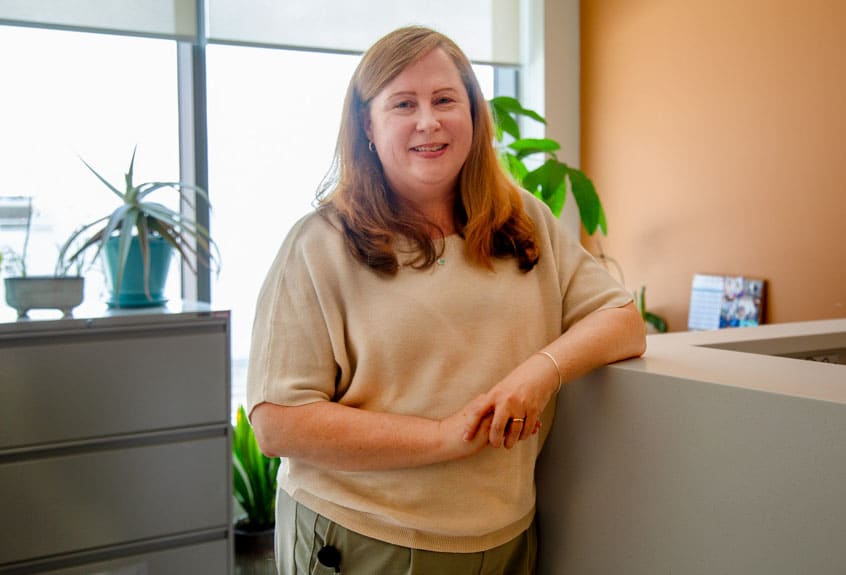
Chances are, Dr. Amanada Bell will find a familiar face wherever she travels in Canada.
It’s one of the perks of serving as assistant dean of McMaster University’s Michael G. DeGroote School of Medicine’s Niagara Regional Campus (NRC) for the past nine years. The students she has taught — now doctors practising throughout Canada — jump at the chance to reconnect with their former mentor.
“I’m proud that across the country, there’s a network of graduates working in a variety of disciplines. No matter where I go, I have someone to have dinner with,” Dr. Bell says. “To see them rise through the ranks brings me so much joy. They’re not only good doctors but good people.”
Dr. Bell, who spent 16 years in total at the NRC, may soon have more opportunities for catch-up dinners with NRC grads. She is stepping down from the post where she has grown the campus’s reputation and impact. Her last day is June 26, with a search for her replacement underway.
“It’s really bittersweet,” she says. “It’s been an absolute privilege and joy to be able to do this. I’m looking forward to having more time for myself and for someone else to take over the campus. Organizations need renewal, new ways of problem-solving and visioning. People are used to the way I’ve suggested doing things and that doesn’t mean it’s the only way.”
That emphasis on the importance of change and the fresh ideas it can bring ushered Dr. Bell into the assistant dean role when she took over from Dr. Karl Stobbe, who founded the NRC in 2007 and led it through its infancy.
As a family physician practising in Niagara, Dr. Bell had enjoyed having medical learners in her office and helping them one-on-one as a mentor. She saw the public health value they brought to improving patient care in the region.
“When I interview a faculty member who was a student previously, my heart is so full because that’s what it’s about.”
As a working physician, she was also aware of the looming health human resources crisis and was steadfast in her belief that Niagara could produce great doctors to help alleviate it.
Dr. Bell brought that to her initial teaching role at the NRC and carried it forward when she took over for Dr. Stobbe in 2017.
“When I made the jump to education, I realized this would help me have the biggest impact,” she says. “If we can equip and prepare (medical learners), they are the ones who are going to get us out of trouble. I never wanted to complain about problems unless I could propose a solution and be part of that solution.”
At the time Dr. Bell started teaching, the campus struggled with its identity and making people aware it not only existed but provided an exceptional education. Working in partnership with a community hospital like Niagara Health offered opportunities that often elude students at larger, urban medical schools. But it took time for the community and prospective learners to recognize that.
When she became assistant dean, Dr. Bell worked to set the NRC along a trajectory of winning over ambassadors, shrinking the ranks of naysayers and building a pipeline of learners to leaders.
At one time, students accepted to the NRC may have felt nervous about coming here but now, they actively choose it because of what it offers, she says. That includes service learning with community organizations like REACH Niagara, where Dr. Stobbe is medical director of the substance use and addictions program, and strong clinical opportunities. The support by McMaster staff helps create a family feel, she notes, while frontline attention from Niagara Health physicians provides a rich and tailored education.
Dr. Bell has also seen the impact the NRC has had on Niagara Health. Physicians are choosing to come here for the teaching opportunities.
“Karl Stobbe was a pioneer. He had a vision, but it was against all odds, against skeptics and even some opponents,” she says. “It was proving our existence and rethinking our presence. Year after year, you have to train really good doctors, have them do great on their exams and get competitive residencies across the board. Then they come back and want to teach.
“That’s full circle,” she adds. “When I interview a faculty member who was a student previously, my heart is so full because that’s what it’s about.”
If they don’t return, that’s OK, too, she says. That network of dinner dates – first and foremost well-trained physicians – is showing a nation what happens in a community-based learning environment and spreading the good name of the NRC far and wide.
Despite the reputational growth Dr. Bell has helped the NRC achieve, her proudest moment was helping to steer the campus through the pandemic.
“On a moment’s notice, we had to change the way education was delivered when information was changing by the minute. But we got everyone through and kept their learning on track.”
As for what’s next, Dr. Bell will continue working in family medicine in south Niagara and with REACH Niagara. She will also stay on as Chief of Staff at the Haldimand War Memorial Hospital in Dunnville. She’ll still be spotted on campus as she helps students work on professionalism.
And she’ll keep building that national network of dining companions.
“I’m saying most frequently, ‘Stay in touch. You know how to reach me,’” Dr. Bell says. “I’m so interested in where students are going. I’m still very much invested. I’ll just be invested from the sidelines.”
